





What's Happening?
NASA has selected SpaceX to provide launch services for its StarBurst mission, a small satellite designed to investigate neutron star mergers and the origins of short gamma-ray bursts. The StarBurst mission is part of NASA's Astrophysics Pioneers Program,
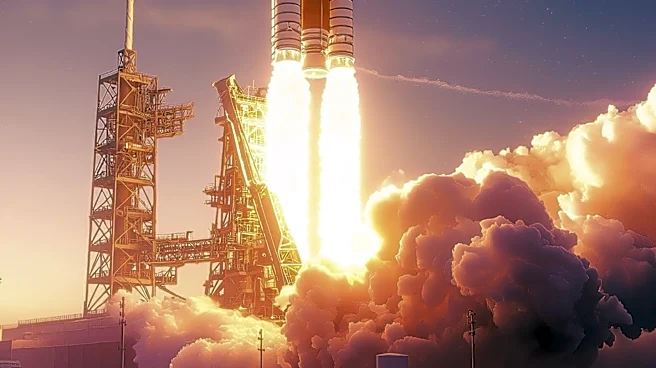
which focuses on lower-cost investigations utilizing small spacecraft and other platforms. The launch is scheduled to occur no earlier than 2028, aboard a Bandwagon rideshare mission on a Falcon 9 rocket from Space Launch Complex 40 at Cape Canaveral Space Force Station in Florida. This selection is a firm-fixed-price task order under NASA’s VADR (Venture-Class Acquisition of Dedicated and Rideshare) launch services contract. This contract allows NASA to procure launch services over a 10-year period, with a total maximum value of $1 billion across all contracts. The StarBurst satellite will observe the entire sky not obscured by Earth to detect brief, powerful gamma-ray bursts, specifically focusing on the initial high-energy emissions from short gamma-ray bursts that result from merging neutron stars. The VADR contract is managed by NASA’s Launch Services Program Office, located at the Kennedy Space Center in Florida.
Why It's Important?
This contract award is significant for several reasons. Firstly, it underscores NASA's continued reliance on commercial partners like SpaceX for critical space missions, reflecting a broader trend in the U.S. space industry towards public-private collaboration. This approach aims to reduce costs and accelerate mission timelines. Secondly, the StarBurst mission itself is crucial for advancing multimessenger astronomy, which combines observations from various types of signals, such as gravitational waves and high-energy emissions, to study cosmic events. Understanding neutron star mergers and gamma-ray bursts provides vital insights into the universe's most extreme phenomena and the origins of heavy elements. The Astrophysics Pioneers Program, under which StarBurst falls, is important for fostering innovation by supporting smaller, more agile missions that can complement larger, more complex projects. This strategy allows for a wider range of scientific investigations and provides opportunities for emerging technologies and research concepts to be tested in space. The long-term VADR contract also provides stability and predictability for both NASA and its commercial launch providers, ensuring access to launch capabilities for future missions.
What's Next?
The next steps for the StarBurst mission involve continued development and preparation for its launch, which is targeted for no earlier than 2028. SpaceX will proceed with the necessary planning and technical preparations for integrating the StarBurst satellite onto a Falcon 9 rocket as part of a Bandwagon rideshare mission. NASA will continue to oversee the development of the StarBurst instrument and ensure its readiness for space operations. Researchers will also be preparing for the data analysis that will follow the mission's launch, anticipating the insights that will be gained from combining StarBurst's gamma-ray observations with other astronomical data, including gravitational-wave measurements. The success of this mission will likely influence future selections under the VADR contract and could further solidify the role of commercial launch services in NASA's scientific endeavors. Additionally, the findings from StarBurst are expected to contribute to the broader scientific community's understanding of high-energy astrophysics and the fundamental processes governing the universe.
Beyond the Headlines
The StarBurst mission and its launch contract with SpaceX highlight a deeper shift in how the U.S. government approaches space exploration and scientific research. The emphasis on 'lower-cost investigations' and 'small spacecraft' through programs like Astrophysics Pioneers signifies a move towards more agile and potentially more frequent scientific missions. This approach could democratize access to space for scientific payloads, allowing a wider array of research questions to be pursued. Ethically, the collaboration with commercial entities raises questions about the balance between public scientific goals and private commercial interests, though in this case, it appears to be a mutually beneficial arrangement. The long-term implications include the potential for a more robust and competitive U.S. space industry, capable of supporting both government and private sector needs. This model could also inspire other nations to adopt similar strategies for their space programs, fostering international collaboration and competition in space science and technology. Ultimately, the success of missions like StarBurst will not only expand human knowledge of the cosmos but also shape the future landscape of space exploration and scientific discovery.