




What's Happening?
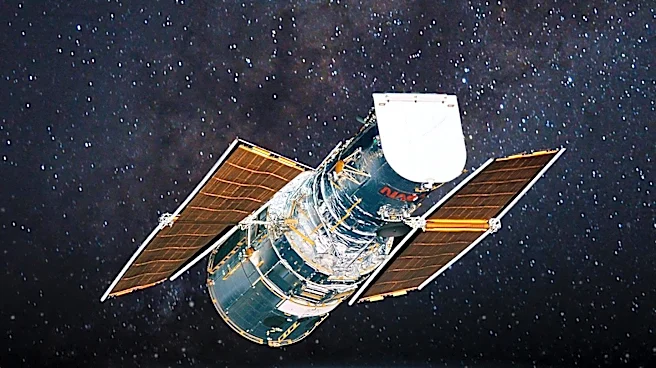
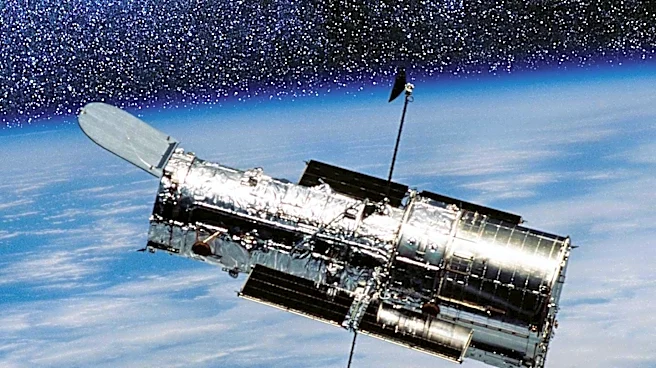
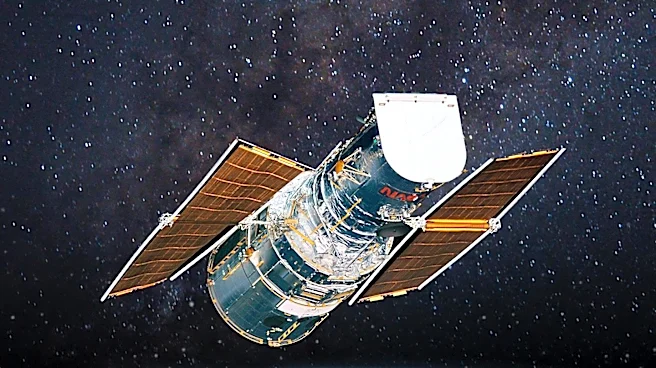
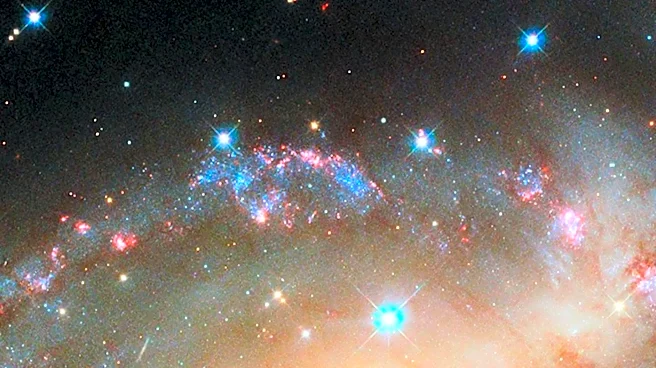
NASA’s Hubble Space Telescope has uncovered a mystery in nearby dwarf galaxies: a significant amount of expected oxygen is missing. A study published in The Astrophysical Journal, utilizing Hubble observations of 37 dwarf galaxies, found that these small
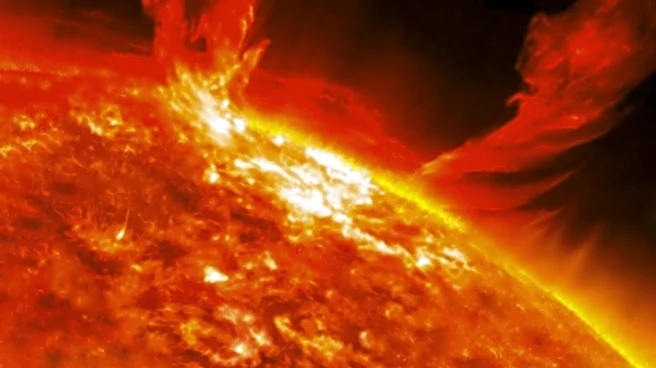
galaxies retain only a fraction of the oxygen produced by their stars. Simulations predicted a much higher oxygen content. Co-investigator Grace Telford, assistant professor at the University of Utah, explained that oxygen, produced by stars, must have been ejected from these galaxies. This ejection is attributed to galactic winds driven by massive stars and supernova explosions, which appear to be more effective at removing oxygen from low-mass galaxies than current models suggest. The Galaxies Losing Oxygen via Winds (GLOW) project, funded by NASA and the National Science Foundation, traced oxygen to understand its distribution within stars, interstellar gas, and intergalactic space. Oxygen is studied because it is abundant, easily detectable, and its production is well understood, making it a reliable indicator of chemical element distribution and galaxy evolution.
Why It's Important?
This discovery challenges current models of galaxy evolution, particularly concerning how chemical elements are distributed and retained in dwarf galaxies. The unexpected efficiency of galactic winds in expelling oxygen from these low-mass systems suggests that our understanding of star formation feedback and its impact on galactic chemical enrichment may need revision. This has broader implications for understanding the chemical evolution of the universe, as dwarf galaxies are thought to be building blocks for larger galaxies. If dwarf galaxies are less efficient at retaining heavy elements like oxygen, it affects how these elements are distributed throughout the intergalactic medium, influencing subsequent star formation and galaxy development. The findings also highlight the critical role of supernovae in shaping galactic environments and the need for more refined simulations to accurately capture these processes.
What's Next?
Researchers plan to extend this study to even lower-mass galaxies in the nearby universe. Kristen Wingfield McQuinn, GLOW principal investigator, has an approved program to use the Nancy Grace Roman Space Telescope to identify faint and tiny systems across a wide sky swath. Following identification, Hubble and the James Webb Space Telescope will be used for deeper observations of their stars to reconstruct their star-formation histories. Grace Telford's future work involves using Hubble to zoom in on individual massive stars that produce and eject oxygen from host galaxies, characterizing how these stars differ in small galaxies. These future observations aim to clarify where the missing oxygen ends up—whether in the circumgalactic medium or completely ejected from the galaxy's surroundings—and to refine models of galaxy evolution.
Beyond the Headlines
The mystery of the missing oxygen in dwarf galaxies touches upon fundamental questions about the universe's chemical inventory and the mechanisms that govern its distribution. It underscores the dynamic interplay between stellar processes and galactic environments, revealing that galaxies are not closed systems but rather constantly exchange matter and energy with their surroundings. This research also highlights the ongoing refinement of astronomical models, where observational data from powerful telescopes like Hubble continually push the boundaries of theoretical understanding. The implications could extend to understanding the conditions necessary for life, as the distribution of elements like oxygen is crucial for the formation of planets and complex chemistry.