









What's Happening?
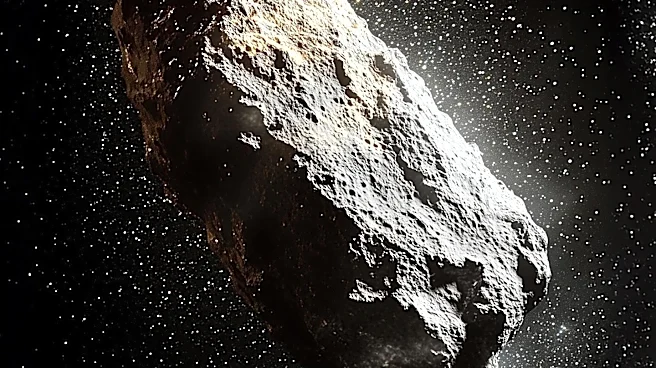
Japan's Hayabusa2 spacecraft successfully conducted a close flyby of the near-Earth asteroid Torifune on July 5, 2026. The mission, managed by the Japan Aerospace Exploration Agency (JAXA), involved a daring approach to within 800 meters of the asteroid,
capturing high-resolution images and data. The flyby revealed Torifune as a contact binary, a structure where two rocks are held together by gravity. This mission was part of Hayabusa2's extended objectives following its primary mission to asteroid Ryugu, where it collected samples and returned them to Earth in 2020.
Why It's Important?
The successful flyby of Torifune demonstrates JAXA's capability to conduct high-risk, close-proximity operations with spacecraft. This mission not only provided valuable scientific data about the asteroid's composition and structure but also showcased technological advancements in spacecraft navigation and imaging. The ability to perform such close flybys is crucial for planetary defense strategies, as it allows for rapid characterization of potentially hazardous asteroids. The mission's success also enhances international collaboration in space exploration and contributes to the global understanding of asteroid dynamics.
What's Next?
Following the Torifune flyby, Hayabusa2 is set to continue its journey towards the asteroid 1998 KY26, with a planned rendezvous in 2031. The spacecraft will conduct two Earth flybys in 2027 and 2028 to adjust its trajectory. Meanwhile, the data collected from the Torifune flyby will be analyzed to gain further insights into the asteroid's properties. JAXA's continued exploration efforts will likely focus on refining techniques for asteroid characterization and developing strategies for potential asteroid deflection missions.
Beyond the Headlines
The mission highlights the growing importance of international cooperation in space exploration, as well as the need for advanced technologies to address planetary defense challenges. The success of Hayabusa2's flyby could inspire future missions to explore other near-Earth objects, contributing to our understanding of the solar system's formation and evolution. Additionally, the mission underscores the potential for space exploration to drive technological innovation and inspire the next generation of scientists and engineers.