



What's Happening?
A new study published in Nature Food reveals that animal agriculture is responsible for a disproportionately large share of global biodiversity and carbon loss on agricultural land. Despite providing less than 15% of humanity’s calories, animal-sourced
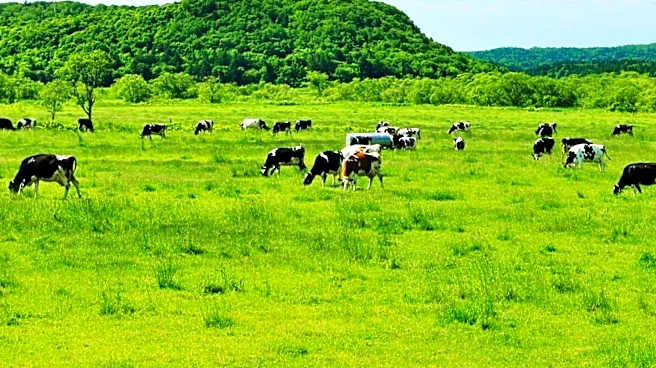
foods contribute to 71% of biodiversity losses and 59% of carbon losses on land used for food production worldwide. The study, which excluded fish and focused on land-based foods, highlights that animal-sourced foods occupy 79% of food-related agricultural land. Researchers found that the environmental footprint of animal-sourced foods is significantly higher per calorie compared to plant-sourced foods, with carbon loss being 8 times higher and biodiversity loss 14 times higher. Cattle meat and dairy alone account for 29% of carbon loss and 41% of biodiversity loss on agricultural land. The impact is largely attributed to the extensive land use required for animals to live, graze, and for growing crops to feed them, often involving methods like monocultures and soil disturbance that lead to higher per-acre carbon and biodiversity losses.
Why It's Important?
This research is crucial for understanding the environmental toll of current food production systems and for informing strategies to mitigate climate change and biodiversity loss. The findings underscore that focusing solely on carbon storage may underestimate the full environmental impact of animal agriculture. By identifying 'hotspots' of concentrated carbon and biodiversity loss, particularly in regions like India, Southeast Asia, and Brazil, the study offers targeted opportunities for intervention. Restoring half of these global hotspots could sequester carbon equivalent to 24 years of current fossil fuel emissions and potentially prevent 11% of species from extinction. The study also reveals that the environmental impacts of food production are often geographically separated from consumption, with countries like Brazil being major net exporters of environmental degradation and China being a significant net importer. This highlights the global interconnectedness of food systems and their environmental consequences, emphasizing the need for international cooperation in policy discussions and consumer choices.
What's Next?
The study's authors intend for these findings to serve as a baseline for further scientific analysis of specific land-use scenarios and the effects of dietary changes. They hope the data will better inform decision-makers as climate mitigation becomes a more central part of policy discussions globally. The research suggests a call to action for consumers, emphasizing that individual consumption decisions have a significant impact. Future efforts may focus on reorganizing global agricultural land use by targeting high-impact products and regions. Integrating these findings into climate and biodiversity policy discussions, which have historically overlooked the food system, is a critical next step. This could lead to policies that promote more sustainable food production and consumption patterns, potentially including incentives for reducing animal-product consumption and supporting plant-based alternatives.
Beyond the Headlines
The study's implications extend beyond immediate environmental concerns, touching upon ethical and systemic issues within the global food industry. The disproportionate land use and environmental damage caused by animal agriculture, despite its relatively low caloric contribution, raise questions about the efficiency and sustainability of current dietary norms. The interconnectedness of climate change and biodiversity loss, as highlighted by the study, suggests that addressing one without the other will be insufficient. Furthermore, the geographical separation of environmental impact from consumption points to a global responsibility for sustainable practices, challenging the notion that environmental problems are solely local. This research could fuel broader discussions about food sovereignty, trade policies, and the ethical considerations of food production, potentially leading to a re-evaluation of how societies value and produce food in the long term.