



What's Happening?
NASA's Nancy Grace Roman Space Telescope is set to embark on an international partnership with the Subaru Telescope on Maunakea, Hawaii. This collaboration, launched on August 30, will involve the Subaru Telescope contributing 100 nights of observations
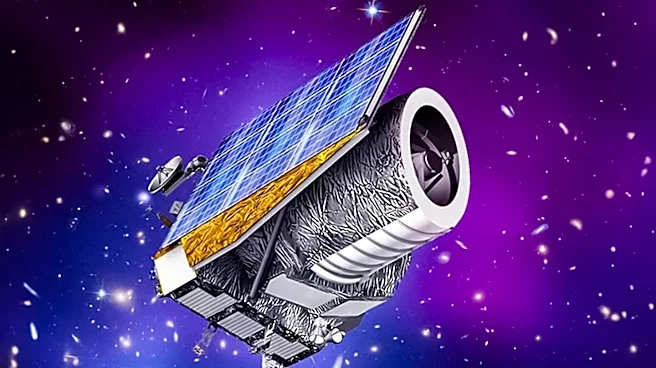
to complement Roman's mission. The Nancy Grace Roman Space Telescope, named after NASA's first chief astronomer and 'mother of the Hubble Space Telescope,' is a 2.4-meter space observatory designed for wide-field surveys of the universe in optical and infrared wavelengths. The Subaru Telescope, an 8.2-meter optical-infrared telescope operated by the National Astronomical Observatory of Japan, has been exploring the universe from Maunakea for over 25 years. Maunakea's high elevation, dry atmosphere, dark skies, and location above much of Earth's weather make it an ideal site for astronomy. Coordinated observations between the two telescopes are expected to commence in 2027 or later.
Why It's Important?
This partnership is significant for advancing astronomical research by combining the unique capabilities of both telescopes. Roman's position above Earth's atmosphere will enable sensitive infrared surveys, while Subaru's large mirror and wide-field instruments can provide detailed information about selected objects identified by Roman. The Subaru Telescope's 'O'onohi'ula Prime Focus Spectrograph can observe approximately 2,400 objects simultaneously, allowing astronomers to follow up on a large number of galaxies and other celestial bodies discovered by Roman. By integrating observations from both space and ground-based platforms, scientists can gain a more comprehensive understanding of the universe than either telescope could achieve independently. This collaboration will help determine the nature, distance, and evolutionary context of distant galaxies and other cosmic phenomena, contributing to a broader understanding of the universe's structure and evolution.
What's Next?
Coordinated observations between the Nancy Grace Roman Space Telescope and the Subaru Telescope are anticipated to begin in 2027 or later. Once operational, Roman will likely identify distant galaxies and other objects through its wide-field infrared surveys. Subsequently, the Subaru Telescope will play a crucial role in characterizing these discoveries, providing detailed spectroscopic data to determine their composition, distance, and how they fit into the larger cosmic narrative. This ongoing collaboration is expected to yield new insights into star formation, galaxy evolution, and the distribution of matter in the universe. The success of this partnership could also pave the way for future international collaborations in space exploration and astronomical research, leveraging diverse observational assets to tackle complex scientific questions.
Beyond the Headlines
The collaboration between NASA's Roman Space Telescope and the Subaru Telescope underscores the growing trend of international cooperation in scientific endeavors, particularly in space exploration. This partnership highlights the global nature of scientific inquiry and the benefits of pooling resources and expertise to achieve ambitious research goals. Furthermore, it emphasizes the continued importance of ground-based observatories, even with the advent of advanced space telescopes. The complementary nature of their capabilities demonstrates that different observational platforms offer unique advantages, and their combined use can unlock deeper scientific understanding. This initiative also reinforces Maunakea's status as a premier astronomical site, attracting significant international scientific investment and collaboration, which could have long-term implications for scientific infrastructure and research opportunities in the region.