
What's Happening?
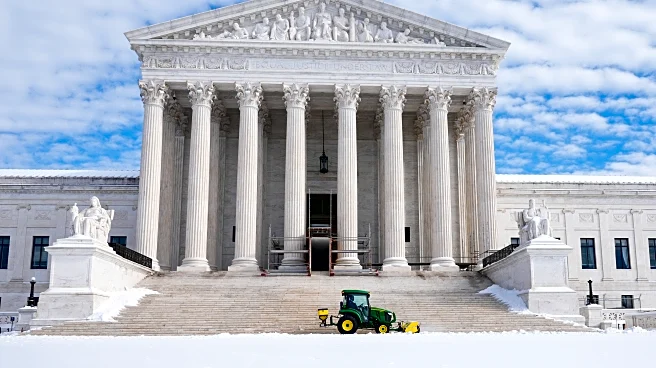
The Supreme Court recently expressed skepticism regarding President Trump's claimed authority to dismiss members of the Federal Reserve Board of Governors without cause. This issue arose when President Trump attempted
to remove Lisa Cook, a Biden appointee, from the board by citing unsubstantiated allegations of mortgage fraud. Justice Brett Kavanaugh highlighted the potential for partisan retaliation if such powers were granted, noting that a future Democratic president could similarly remove Trump-appointed members. The case underscores the legal complexities surrounding the president's power to influence the Federal Reserve, a body traditionally insulated from political pressures to maintain economic stability.
Why It's Important?
The outcome of this case could significantly impact the independence of the Federal Reserve, a cornerstone of U.S. economic policy. If the court sides with President Trump, it could set a precedent allowing future presidents to reshape the Fed's composition based on political affiliations, potentially undermining its role in managing monetary policy free from political influence. This could lead to increased market volatility and uncertainty, affecting economic stakeholders ranging from investors to everyday consumers. The decision also reflects broader concerns about the expansion of executive power and its implications for democratic governance.
What's Next?
The Supreme Court's decision will be closely watched by political leaders, economists, and market participants. A ruling in favor of President Trump could prompt legislative efforts to reinforce the Fed's independence. Conversely, a decision against the president might deter future attempts to politicize the board. The case may also influence upcoming presidential elections, as candidates could leverage the issue to appeal to voters concerned about economic stability and executive overreach.
Beyond the Headlines
This case highlights the ongoing debate over the balance of power between the executive branch and independent agencies. It raises ethical questions about the extent to which political considerations should influence economic policy. The decision could also prompt a reevaluation of the legal frameworks governing the appointment and removal of officials in other independent agencies, potentially leading to broader reforms aimed at safeguarding institutional integrity.