








What's Happening?
Scientists have successfully reconstructed the calls of Jurassic relatives of modern-day crickets and katydids, providing insights into the soundscape of 165-million-year-old forests. The research, published in the Proceedings of the National Academy
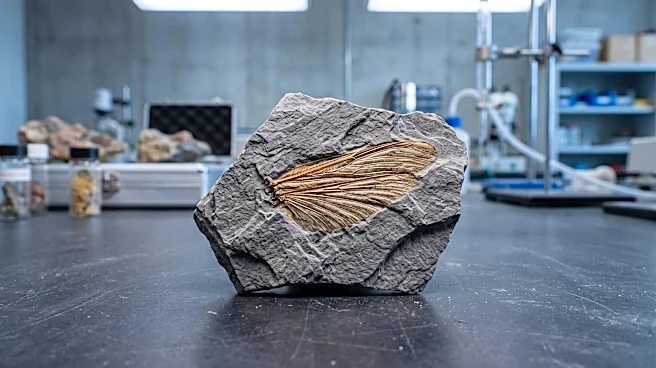
of Sciences, involved examining 20 fossilized wings from nine species of katydid relatives discovered in Inner Mongolia, China. The team focused on the microscopic, tooth-like ridges on the wings, which produce sound when rubbed by a scraper on the opposite wing. By measuring these structures and incorporating data from modern insects and their phylogenetic relationships into computer models, researchers determined the frequency and basic structure of each ancient call. A machine learning model then estimated the likely call rates to create a hypothetical Jurassic soundscape. The results revealed a rich acoustic environment, with many species producing pure-tone calls at around 5 kHz, similar to living crickets. Notably, one species, Sigmaboilus peregrinus, appears to have produced high-frequency ultrasonic calls above 20 kilohertz.
Why It's Important?
This study significantly advances our understanding of ancient ecosystems and the evolution of communication. The discovery of ultrasonic calls in Jurassic insects challenges the long-held hypothesis that bats were the sole drivers behind the evolution of ultrasonic communication. This suggests that insects developed sophisticated acoustic signaling much earlier than previously thought, likely in response to other evolutionary pressures. The diversity of acoustic signals observed indicates complex communication strategies within these ancient insect communities. Such findings provide crucial context for understanding the co-evolutionary arms race between predators and prey, as early mammals and other predators with sensitive hearing may have driven insects to evolve methods of avoiding detection. The ability to reconstruct ancient soundscapes offers a unique sensory window into prehistoric life, complementing visual and anatomical fossil evidence.
What's Next?
Future research will likely delve deeper into identifying other potential drivers for the evolution of ultrasonic communication in ancient insects, beyond the presence of bats. Scientists may explore the acoustic environments of other prehistoric periods and geographical locations to see if similar patterns of early ultrasonic signaling emerge. The methodologies developed in this study, combining fossil analysis, computer modeling, and machine learning, could be applied to reconstruct the sounds of other extinct animals, potentially revealing more about their behaviors, social structures, and ecological roles. This could lead to a more comprehensive understanding of how sound shaped ancient ecosystems and the evolutionary trajectories of various species. Further investigations into the specific anatomical features responsible for sound production in these fossils could also provide more detailed insights into the biomechanics of ancient insect communication.
Beyond the Headlines
The reconstruction of a 165-million-year-old soundscape offers a profound shift in how we perceive ancient life, moving beyond static visual representations to an auditory experience. This research highlights the often-overlooked role of sound in evolutionary processes and ecological interactions. The finding that insects developed ultrasonic communication independently of bats suggests a convergent evolutionary path, where similar environmental pressures can lead to analogous biological solutions. This has implications for understanding the fundamental principles of evolution and adaptation. Furthermore, the study underscores the incredible detail preserved in fossils, demonstrating that even microscopic structures can yield significant insights into complex biological functions. It encourages a multi-sensory approach to paleontology, enriching our appreciation of the complexity and dynamism of prehistoric worlds.