
What's Happening?
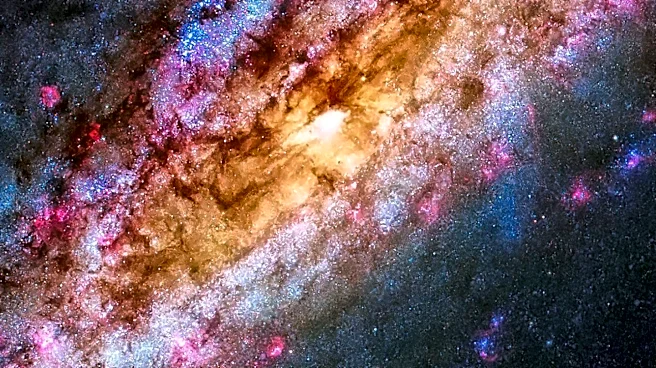
A new simulation from the SMUGGLE-Ring project has provided insights into the formation of central galactic structures, specifically nuclear star clusters and nuclear stellar disks, in Milky Way-like galaxies. The study, led by Dr. SungWon Kwak, demonstrates
how these structures grow together over billions of years, driven by the galaxy's stellar bar. The simulation reveals that the bar channels gas inward, feeding both structures simultaneously. This process has been difficult to observe directly in real galaxies, but the simulation offers a comprehensive view of the evolution of these features.
Why It's Important?
The findings from this simulation are significant for astrophysics, as they offer a new understanding of the processes that shape the centers of galaxies. By bridging theory and observation, the study provides a clearer picture of how nuclear star clusters and stellar disks develop, which has implications for understanding galaxy formation and evolution. The research also highlights the role of dark matter dynamics in these processes, contributing to the broader knowledge of cosmic structures. This advancement in simulation technology could lead to more accurate models and predictions in astrophysical research.
Beyond the Headlines
The study challenges previous assumptions about the disconnection between nuclear star clusters and stellar disks, suggesting that their growth is interconnected. This insight may influence future observational strategies and theoretical models in astrophysics. The inclusion of realistic dark matter dynamics in the simulation underscores the complexity of galactic evolution, potentially leading to new discoveries about the interaction between stars and dark matter. The research also opens up possibilities for exploring the impact of mergers on galactic centers, which could affect the mass and behavior of supermassive black holes.