


What's Happening?
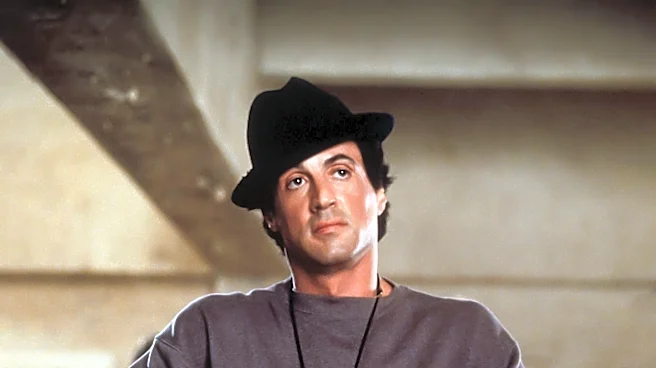
Sylvester Stallone revealed he was caught off-guard and subsequently declined President Trump's appointment of him as a 'Special Envoy' to Hollywood. In January 2025, days before his second inauguration, President Trump announced on Truth Social that
Stallone, Mel Gibson, and Jon Voight would serve as his 'eyes and ears' in Hollywood to advise on bringing film and television production back to the U.S. Stallone learned of this appointment while watching television and expressed his surprise and hesitation, stating that he didn't believe the role was feasible. He later communicated his refusal to President Trump, explaining that Hollywood operates as 'feudal states' with established kingdoms, making it impossible for an outsider to dictate how six studios should operate. Stallone also noted that he, Gibson, and Voight are individuals who prefer to 'do our own thing,' making such a collective advisory role impractical.
Why It's Important?
This event highlights the complexities and potential friction points between political administrations and the entertainment industry. President Trump's initiative aimed to revitalize U.S. film and television production, suggesting a desire to influence an industry often perceived as having distinct political leanings. Stallone's refusal underscores the independent nature of Hollywood's corporate structure and its resistance to external political directives. His perspective that 'Hollywood works, and it will evolve' suggests a belief that the industry's dynamics are best left to its internal mechanisms rather than political intervention. This situation also reveals the challenges of appointing public figures to governmental roles without prior consultation, potentially leading to public rejections and undermining the intended message of unity or support. The broader implication is the ongoing tension between political leadership seeking to exert influence over cultural industries and those industries' desire for autonomy.
What's Next?
Despite Stallone's rejection, Jon Voight, another appointee, appears to have embraced his role as a special ambassador, meeting with the White House and advocating for policies like a federal film tax incentive. President Trump subsequently supported a federal film and television production incentive, urging Congress to pass bipartisan legislation to 'save' the American entertainment business. This indicates that while Stallone may not be directly involved, the administration's goal of bringing production back to the U.S. continues to be pursued through other channels and individuals. The involvement of figures like Senator Adam Schiff and Representative Laura Friedman in supporting President Trump's proposal suggests potential bipartisan efforts to address the issue of film and TV production, regardless of the initial appointments' outcomes. The focus will likely shift to legislative efforts and the engagement of other industry stakeholders.
Beyond the Headlines
The incident touches upon the broader theme of celebrity involvement in politics and the expectations placed upon public figures. While Stallone has a history of supporting both Republican and Democratic candidates, his reluctance to accept a formal political role highlights a distinction between personal political leanings and official governmental appointments. His reasoning, focusing on the impracticality of dictating to Hollywood studios, points to the deep-seated corporate and creative structures within the entertainment industry that are not easily swayed by political appointments. This situation also raises questions about the effectiveness of symbolic appointments versus substantive policy changes in addressing industry concerns. The differing responses from Stallone and Voight illustrate the varied approaches celebrities take when approached for political roles, reflecting individual comfort levels with political engagement and the perceived feasibility of such positions.