


What's Happening?
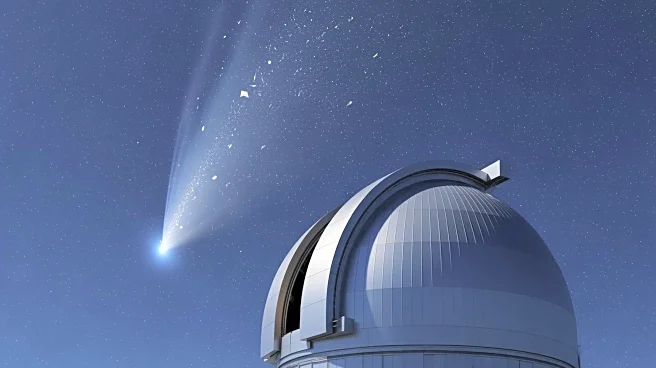
The Gemini North telescope in Hawaii has captured the dramatic disintegration of Comet C/2025 K1 (ATLAS) as it emerged from behind the sun. Initially discovered in May 2025 by the Asteroid Terrestrial-impact Last Alert System (ATLAS), the comet was closely
monitored as it approached the sun. On October 8, 2025, the comet came within 31 million miles of the sun, a distance that typically results in significant brightening due to sublimation of its icy components. However, Comet K1 did not brighten enough to be visible to the naked eye. By early November, the comet's nucleus began to break apart, a common occurrence due to extreme solar heating and gravitational forces. The Gemini North telescope's images show the comet breaking into three distinct fragments, providing a spectacular view of its demise.
Why It's Important?
The disintegration of Comet C/2025 K1 (ATLAS) offers valuable insights into the behavior of comets when they approach the sun. Understanding these processes is crucial for astronomers as it helps predict the fate of other comets and their potential visibility from Earth. The event also highlights the capabilities of modern telescopes like Gemini North in capturing detailed images of celestial phenomena. Such observations contribute to the broader field of astronomy by enhancing knowledge about cometary structures and their interactions with solar forces. This information is vital for future studies and could influence how astronomers plan observations of similar events.
What's Next?
Following the disintegration of Comet K1, astronomers are now focusing on Comet C/2026 A1 (MAPS), another comet on a trajectory towards the sun. Expected to make a close pass on April 4, 2026, within 465,000 miles of the sun's surface, Comet A1 presents another opportunity for observation. If it survives the encounter, it could become as bright as Venus, offering a spectacular view. However, like Comet K1, it faces the risk of disintegration due to intense solar heat and gravity. The outcome will be closely watched by astronomers worldwide, potentially providing further insights into cometary behavior.