

What's Happening?
An attack by the United States and Israel on Iran has led to significant disruptions in air travel across the Middle East and beyond. The conflict prompted several countries, including Israel, Qatar, Syria, Iran, Iraq, Kuwait, and Bahrain, to close their
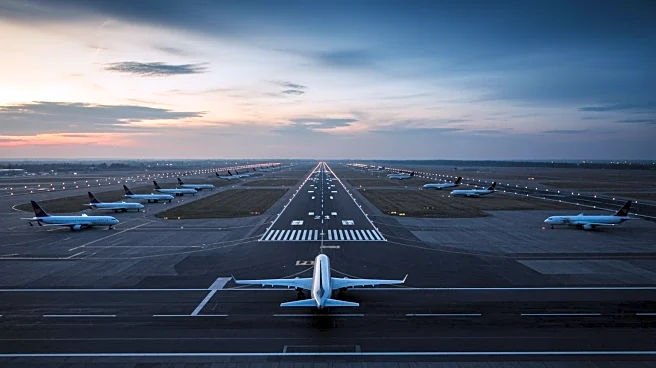
airspace. This closure affected major airports in Dubai, Abu Dhabi, and Doha, leading to the cancellation of over 1,800 flights. Airlines such as Emirates, Qatar Airways, and Etihad, which operate through these hubs, have been significantly impacted. The situation has left hundreds of thousands of travelers stranded or forced to reroute, with some flights being diverted to alternative airports in cities like Athens, Istanbul, and Rome. The disruption is expected to continue for several days, with airlines advising passengers to check their flight status and prepare for potential delays or cancellations.
Why It's Important?
The flight disruptions have far-reaching implications for the global aviation industry and travelers. The closure of key airspaces and airports in the Middle East affects not only regional travel but also international routes connecting Europe, Africa, and Asia. Airlines are facing increased operational costs due to longer flight paths and additional fuel consumption, which could lead to higher ticket prices if the conflict persists. The situation also places additional pressure on air traffic controllers in regions like Saudi Arabia, which are now handling increased traffic. The economic impact extends to countries that rely on overflight fees, which they will miss out on during the airspace closures. The uncertainty surrounding the conflict and its duration adds to the complexity of managing international travel logistics.
What's Next?
In the coming days, countries involved in the airspace closures may begin to reopen parts of their airspace as the situation evolves and more information becomes available about military operations. Airlines are likely to continue adjusting their routes and schedules to accommodate the ongoing disruptions. Travelers are advised to remain flexible and explore alternative travel arrangements. The aviation industry will closely monitor the situation, with potential adjustments to flight operations based on the conflict's developments. The duration of the disruption remains uncertain, drawing comparisons to a similar incident in June 2025 that lasted 12 days.