




What's Happening?
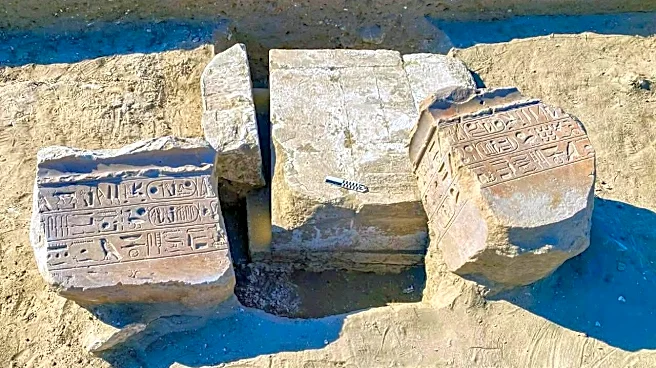
The ancient site known as Ploutonion, or Pluto’s Gate, in Hierapolis, which Romans believed was a direct connection to the underworld, has been found to have a toxic secret. Animals venturing near the cave's opening would die, while priests could emerge
unharmed. This phenomenon, once attributed to the 'breath of Cerberus,' is now understood to be due to the high concentration of carbon dioxide emanating from the cave. Hierapolis, located in western Anatolia, became a significant spa destination after the Roman Republic established it as a province in 129 B.C. The city's thermal springs, which are rich in minerals and carbon dioxide, are a result of its location on the 21-mile-long Pamukkale fault. Ancient Greco-Romans, lacking geological understanding, interpreted these natural occurrences as divine messages, leading to the city being named Hierapolis, meaning 'sacred city' in Ancient Greek.
Why It's Important?
This discovery is important for understanding how ancient civilizations interpreted natural phenomena and integrated them into their religious and cultural beliefs. The 'Gate to Hell' served as a powerful symbol of the underworld, influencing religious practices and pilgrimage to Hierapolis. The ability of priests to enter and exit the toxic cave unharmed likely contributed to their perceived divine authority and the mystique of the site. This historical context sheds light on the development of early religious systems and how environmental factors shaped human societies. It also highlights the scientific advancements that now allow us to explain phenomena that were once considered supernatural, offering a bridge between ancient beliefs and modern understanding of geology and atmospheric science.
What's Next?
Further archaeological and scientific studies at Pluto's Gate could provide more insights into the specific concentrations of gases present and the exact mechanisms that allowed priests to survive the toxic environment, potentially through understanding air currents or specific rituals. Researchers may also explore other ancient sites with similar geological features to see if comparable interpretations of 'gates to the underworld' existed. The site continues to be a point of interest for historians and archaeologists, offering a unique window into the intersection of ancient religion, geology, and human perception. Efforts to preserve and interpret the site for educational purposes will likely continue, allowing future generations to learn from this historical and scientific marvel.
Beyond the Headlines
The story of Pluto's Gate delves into the profound human tendency to seek meaning in the natural world, especially in phenomena that defy immediate explanation. It underscores how fear and reverence for the unknown can shape religious narratives and societal structures. The priests' ability to navigate the toxic environment, whether through specific knowledge or ritualistic practices, highlights the power dynamics within ancient societies where religious leaders often held unique access to perceived divine knowledge. This historical example serves as a reminder of the ongoing human quest to understand our environment and the evolution of scientific thought from mythological explanations to empirical understanding. It also touches upon the ethical considerations of interpreting ancient beliefs through a modern scientific lens.