




What's Happening?
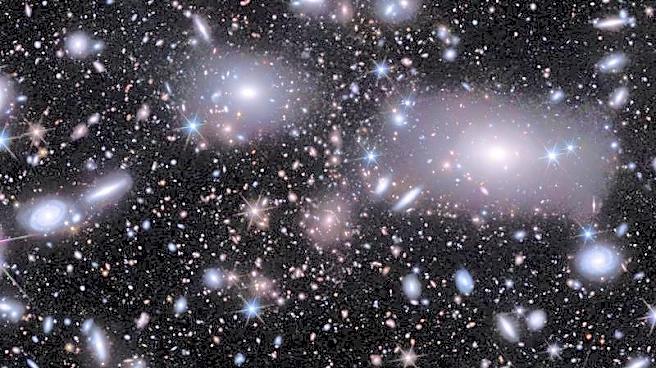
Three unusual galaxies, DF2, DF4, and DF9, located approximately 65 million light-years from Earth, have been observed to possess very little dark matter. These 'ghostly' galaxies are dimly illuminated by a small number of stars, and their masses indicate
a significant deficit of the invisible substance believed to hold most galaxies together. A study published in June 2026 in The Astrophysical Journal proposes a potential explanation: a past collision between two regular galaxies. During this collision, the ordinary matter (gas and dust) clumped together, while the dark matter, experiencing little friction, passed through. This cosmic event is theorized to have left behind these three new galaxies, largely devoid of dark matter, which subsequently struggled to form stars. This observation supports the idea that dark matter is a physical entity rather than merely a modification of gravity.
Why It's Important?
The discovery of galaxies with a significant lack of dark matter is a critical development in the ongoing debate about the nature of dark matter. For decades, cosmologists have proposed various candidates for dark matter, from WIMPs to primordial black holes. However, some scientists have suggested that dark matter might not exist at all, and that observed gravitational effects could be explained by tweaking the laws of gravity (Modified Newtonian Dynamics, or MOND). These 'ghostly' galaxies provide strong evidence against the MOND hypothesis. If gravity were simply modified, it would be difficult to explain how ordinary matter could be separated from the gravitational effects attributed to dark matter. The observed separation in these galaxies strongly suggests that dark matter is a distinct, physical component of the universe, interacting primarily through gravity but not through other fundamental forces like electromagnetism. This finding helps to narrow down the theoretical possibilities and guides future research into the particle nature of dark matter.
What's Next?
Astronomers and physicists will likely conduct further observations of DF2, DF4, and DF9, as well as search for other similar dark-matter-deficient galaxies, to confirm and expand upon these findings. More detailed studies of their stellar populations, gas content, and kinematics could provide additional clues about their formation history and the properties of dark matter. The theoretical community will continue to refine models of galaxy collisions and dark matter interactions to better explain the observed phenomena. This research will also inform the design of future dark matter detection experiments, as understanding how dark matter behaves in extreme environments like galaxy collisions can provide crucial insights into its fundamental properties. The focus will remain on finding direct or indirect evidence of dark matter's particle nature.
Beyond the Headlines
The existence of dark matter challenges our fundamental understanding of the universe and its constituents. The 'ghostly' galaxies highlight the profound implications of dark matter's nature, suggesting that the universe is far more complex than what is visible. This discovery pushes the boundaries of scientific inquiry, forcing a re-evaluation of cosmological models and potentially leading to new physics beyond the Standard Model. The ethical implications involve the allocation of significant resources to fundamental research, which, while not immediately practical, expands human knowledge and understanding of the cosmos. The long-term shift could be a more complete and unified theory of everything, incorporating both visible and dark matter, and potentially revealing new dimensions or particles that govern the universe.