




What's Happening?
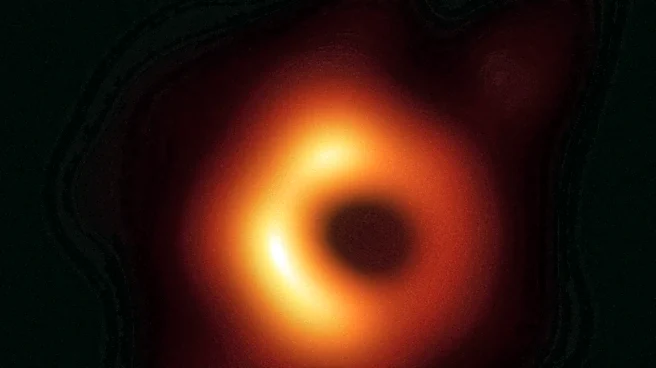
A new study published in Nature has independently validated the iconic image of the supermassive black hole at the center of galaxy M87, originally captured by the Event Horizon Telescope (EHT) Collaboration in 2019. The initial image, which depicted
a black hole 'shadow' outlined by swirling hot gas, confirmed predictions from Einstein's theory of general relativity and supported the existence of supermassive black holes in galactic centers. Despite its significance, some scientists had raised questions regarding the accuracy of the ring's details and structure. Researchers developed new techniques, including a data combination method called 'closure invariants' and a machine learning imaging method named GenDIReCT, to re-examine the original data sets. Their findings not only confirm the original work but also offer a fresh perspective on the black hole's ring structure, enhancing confidence in one of modern science's most significant results.
Why It's Important?
This independent validation is crucial for the scientific community, as it reinforces the reliability of complex astronomical imaging techniques and the fundamental understanding of black holes. The EHT's initial achievement was akin to photographing a doughnut on the moon from Earth, requiring an Earth-sized virtual telescope. The new methods address potential biases and errors that can arise from combining data from a sparse telescope array and individual radio telescopes. By developing techniques that eliminate atmospheric and instrumental errors and minimize human and algorithmic biases, the study strengthens the credibility of the EHT's findings. This increased confidence in the imaging of distant cosmic phenomena can pave the way for more accurate observations and a deeper understanding of the universe's most extreme environments, impacting future astrophysical research and potentially other fields requiring multi-sensor data integration.
What's Next?
The new techniques developed for this study, particularly the 'closure invariants' method, have broader applications beyond astrophysics. Researchers suggest that this method could be useful in other situations where data from multiple sensors are combined to map unknown structures. Potential future applications include medical imaging, where precise mapping of internal structures is critical, and mapping earthquakes, which requires integrating data from various seismic sensors. This indicates a potential for cross-disciplinary impact, where advancements in astronomical research methodologies could benefit other scientific and technological fields. Continued refinement and application of these techniques could lead to more accurate and reliable data analysis across diverse domains.
Beyond the Headlines
The validation of the M87 black hole image underscores the ongoing scientific pursuit of understanding the universe's most enigmatic objects. The initial EHT image was a monumental achievement, pushing the boundaries of observational astronomy. The subsequent independent validation, addressing concerns about data interpretation and potential biases, highlights the rigorous self-correction mechanisms inherent in the scientific process. It demonstrates how new methodologies, including advanced machine learning, can be developed and applied to scrutinize and confirm groundbreaking discoveries. This iterative process of discovery, challenge, and re-validation is fundamental to scientific progress, ensuring that our understanding of the cosmos is built on the most robust evidence possible. The ability to 'see' and confirm such distant and extreme phenomena continues to inspire public interest in science and space exploration.