






What's Happening?
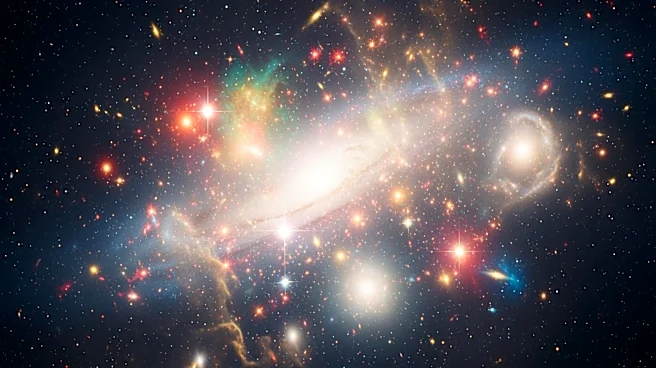
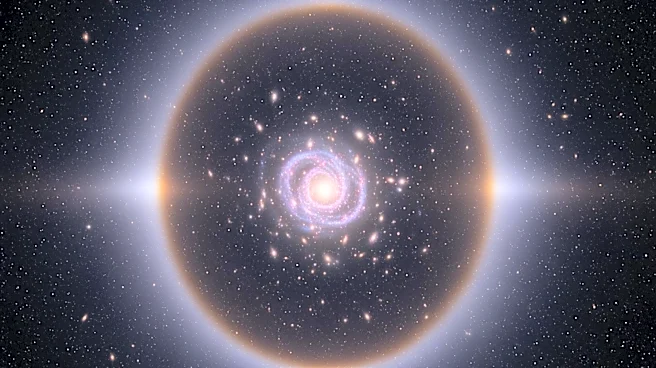
A team of astronomers has confirmed the existence of a giant radio halo extending over 3.3 million light-years within the galaxy cluster RXCJ0232-4420. This discovery was made using the upgraded Giant Metrewave Radio Telescope (uGMRT) and South Africa’s
MeerKAT telescope. The findings, published on the arXiv preprint server, reveal that the radio emissions extend far beyond what was previously thought possible in a relatively calm cluster environment. The cluster, discovered in 2002, had earlier been the subject of conflicting interpretations regarding its radio emissions. The new observations have identified not only the giant radio halo but also an eastern radio relic with a linear size of approximately 980,000 light-years. The cluster contains two brightest cluster galaxies, BCG-A and BCG-B, separated by about 330,000 light-years.
Why It's Important?
This discovery is significant as it challenges the existing understanding of radio halos in galaxy clusters, particularly those that maintain a cool core. Typically, giant radio halos are associated with clusters undergoing violent mergers, but RXCJ0232-4420 appears to be in an intermediate dynamical state with only mild structural disturbances. The presence of such a large radio halo in a relatively undisturbed cluster suggests that charged particles are being re-energized across much of the cluster, rather than in isolated spots. This could lead to a reevaluation of the conditions necessary for the formation of giant radio halos and may impact future studies on the evolution of galaxy clusters.
What's Next?
Further research is likely to focus on understanding the mechanisms behind the re-energization of charged particles across the cluster. Additional observations using other wavelengths, such as X-ray and optical, could provide more insights into the cluster's dynamics and the relationship between radio and X-ray emissions. This could help refine models of galaxy cluster evolution and the role of radio halos in these processes. The findings may also prompt astronomers to re-examine other galaxy clusters previously thought to be quiet, potentially uncovering more hidden radio halos.
Beyond the Headlines
The discovery of a giant radio halo in a cluster with a cool core raises questions about the energy processes at play in such environments. It suggests that even in less disturbed clusters, significant non-thermal processes can occur, potentially altering the thermal history of the cluster. This could have implications for our understanding of cosmic magnetism and the lifecycle of galaxy clusters. The study also highlights the importance of using multi-wavelength observations to gain a comprehensive view of cosmic phenomena.