





What's Happening?
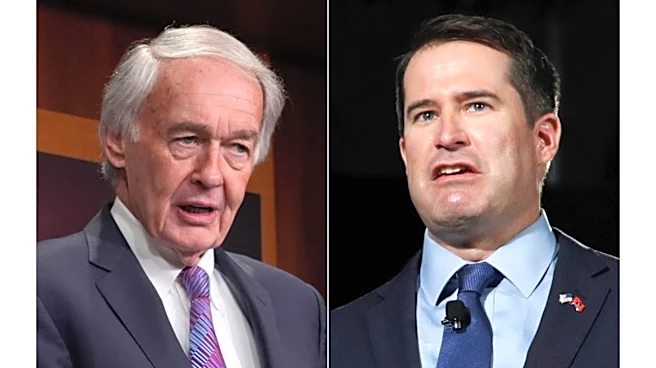
The Massachusetts Senate primary race between incumbent Senator Ed Markey and challenger U.S. Representative Seth Moulton is highlighting a generational divide among Democratic voters. Senator Markey, 80, is emphasizing his 50-year record and progressive
achievements, including co-authorship of the Green New Deal and early support for Medicare for All. He has garnered endorsements from prominent progressives like U.S. Representative Alexandria Ocasio-Cortez and Senator Bernie Sanders, and has strong support from young progressive groups such as the High School Democrats of America and the College Democrats of America. Conversely, Representative Moulton, 47, is campaigning on a platform of generational change, arguing that younger leaders are better equipped to address contemporary issues like artificial intelligence, rising housing costs, and student debt. Some young voters supporting Moulton express concern that older politicians may not fully grasp the complexities of a rapidly evolving world, citing Markey's perceived lack of familiarity with AI platforms during a recent debate. However, many of Markey's younger supporters view his extensive experience as an asset, providing a proven track record of progressive advocacy.
Why It's Important?
This primary race is a significant test of the Democratic Party's direction, serving as a proxy battle between the value of long-standing experience and the call for generational change. The outcome will indicate whether Democratic voters, particularly younger ones, prioritize a candidate's established progressive record and institutional leverage or a fresh perspective and a more contemporary understanding of emerging challenges. The debate over age and policy competence, exemplified by Markey's response to an AI question, underscores a broader concern about the relevance of long-serving politicians in an era of rapid technological and societal shifts. The split among young voters, with some backing Markey for his policy achievements and others supporting Moulton for his forward-looking approach, reveals the nuanced and diverse priorities within the Democratic electorate. This election could set a precedent for how the party navigates the balance between honoring its veteran leaders and embracing new voices and ideas.
What's Next?
As the primary election approaches, both campaigns will intensify their efforts to mobilize their respective bases. Senator Markey will continue to leverage his endorsements from national progressive figures and highlight his legislative achievements to appeal to voters who value experience and a proven track record. Representative Moulton will likely double down on his message of generational change, aiming to attract voters who feel the current political establishment is not adequately addressing their concerns. The election results will be closely watched to determine the prevailing sentiment within the Massachusetts Democratic Party and its implications for future elections across the country. The outcome will provide insights into whether the argument for 'generational change' is a winning message or if voters continue to prioritize established progressive credentials and experience in leadership roles. The race also serves as a barometer for how the Democratic Party will address the evolving needs and expectations of its diverse voter base.
Beyond the Headlines
The Massachusetts Senate primary transcends a simple electoral contest, touching upon fundamental questions about leadership, representation, and the future of the Democratic Party. The tension between experience and innovation, and the perceived disconnect between older politicians and the challenges faced by younger generations, are themes that resonate far beyond this specific race. The debate over a candidate's understanding of complex technologies like AI highlights the increasing importance of technological literacy in political leadership. Furthermore, the split among young voters demonstrates that 'youth' does not equate to a monolithic political viewpoint, with diverse priorities and values shaping their electoral choices. This election offers a valuable case study in how a major political party grapples with internal ideological and generational divides, and how it seeks to adapt to a changing political landscape while maintaining its core principles and appealing to a broad coalition of voters.