






What's Happening?
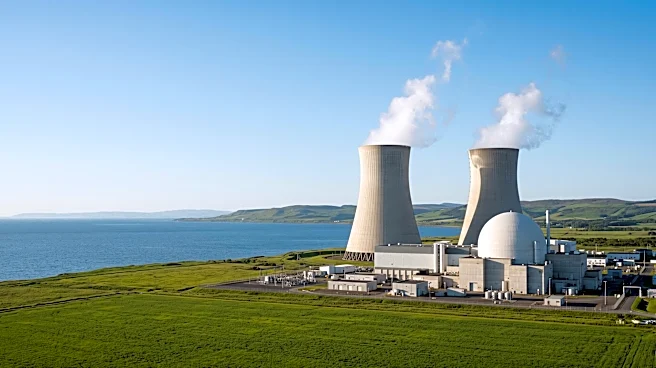
A new report from the Energy Transitions Commission (ETC), titled 'The Role of Nuclear in the Energy Transition: Complementary but Limited,' provides a measured assessment of nuclear power's potential. The report suggests that nuclear energy could supply
up to 10% of the global electricity supply by 2050, effectively doubling the current 380 GW capacity to 750 GW. This expansion would require an average annual new nuclear capacity growth of 15–25 GW, up from the current 5 GW per year, backed by an annual investment of $200 billion, a significant increase from today's $50 billion. The ETC emphasizes that the economic viability of nuclear expansion varies significantly by country, with some nations, like the UK, potentially benefiting from increased nuclear generation, while others, such as India, find solar resources with batteries to be more cost-effective.
Why It's Important?
This report is crucial for understanding the realistic role of nuclear power in achieving global decarbonization goals, especially amidst surging power demand from AI data centers and heightened energy security concerns. It highlights that while nuclear energy offers a carbon-free power source, its economic competitiveness often lags behind solar and wind in most countries. The report also points out that the cost of building similar reactor designs can be 4–9 times higher in the U.S. and Europe compared to China and South Korea, largely due to differences in standardization, regulatory frameworks, and financing costs. This disparity impacts the feasibility of nuclear projects and influences national energy strategies, affecting investment decisions and the pace of energy transition in various regions.
What's Next?
To achieve the ETC's central estimate of 750 GW by 2050, new nuclear construction must increase significantly, requiring substantial annual investment. The report suggests that lifetime extensions of existing reactors, from 60 to 80 years, represent the most cost-effective way to maintain nuclear capacity, with 12 U.S. plants already approved for 80-year operation. However, the widespread deployment of small modular reactors (SMRs) is still 1-2 decades away, with current U.S. cost estimates for SMRs being significantly higher than large reactors. Addressing supply chain concentration, particularly Russia's 40% share of global uranium enrichment capacity, will be critical for ensuring energy security and diversifying nuclear fuel sources. Future developments will likely involve continued debate and investment in both new nuclear builds and existing plant extensions, alongside efforts to reduce construction costs and diversify supply chains.
Beyond the Headlines
The report delves into the nuanced debate surrounding nuclear energy, moving beyond a binary 'accept or reject' approach. It underscores that while nuclear can be a valuable complement to renewables, it is not a universal solution for all countries due to varying economic and resource landscapes. The significant cost disparities in nuclear construction between Western nations and countries like China and South Korea highlight underlying issues in project management, regulatory efficiency, and financing structures. Furthermore, the report brings attention to the geopolitical risks associated with concentrated nuclear supply chains, particularly Russia's dominance in uranium enrichment. This emphasizes the need for strategic international cooperation and investment in diversifying these critical supply chains to ensure the long-term viability and security of nuclear power as a component of the global energy mix.