
What's Happening?
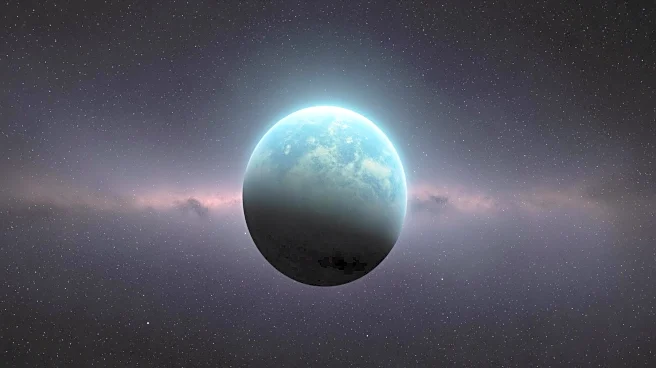
Astronomers have confirmed the existence of a rare free-floating exoplanet, approximately the size of Saturn, located nearly 10,000 light-years from Earth. This discovery was made possible through the observation
of a microlensing event, where the planet's gravitational field distorted the light from a distant star. The event was observed using several ground-based observatories and the European Space Agency's Gaia space telescope. The planet, identified as KMT-2024-BLG-0792, is estimated to have a mass about 70 times that of Earth. This finding supports the theory that such rogue planets, which do not orbit a star, are more abundant in the Milky Way than previously thought.
Why It's Important?
The confirmation of this free-floating exoplanet provides significant insights into the formation and abundance of rogue planets in the Milky Way. These planets, which drift through space without a star, challenge existing models of planetary formation and dynamics. The discovery suggests that rogue planets may be more numerous than stars in our galaxy, indicating a need to revise current astronomical theories. This could have profound implications for our understanding of planetary systems and the processes that lead to the ejection of planets from their original systems.
What's Next?
Future space telescopes, such as NASA's Nancy Grace Roman Space Telescope and China's Earth 2.0 satellite, are expected to enhance the detection of rogue planets. These advanced instruments will scan large areas of the sky in infrared light, potentially identifying more free-floating planets and providing further data to refine our understanding of their characteristics and distribution. This ongoing research could lead to breakthroughs in the study of planetary formation and the dynamics of planetary systems.