







What's Happening?
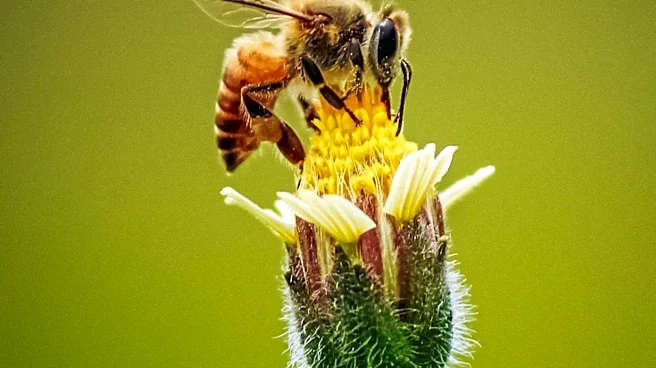
Researchers from Heinrich Heine University Düsseldorf and other institutions have identified brain circuits that determine the roles of worker bees within a colony. By manipulating a gene known as doublesex, scientists were able to change bee behavior
and control which tasks the worker bees performed. The study, published in the Proceedings of the National Academy of Sciences, reveals that task organization in bee colonies has a neural foundation. When activity in specific brain areas is reduced, other neural circuits become active, triggering different behaviors. This discovery provides insight into how bees efficiently divide labor without a central planner.
Why It's Important?
Understanding the neural basis of task organization in bee colonies could have broader implications for studying social behavior and cooperation in other species, including humans. The ability to control bee behavior through neural circuits offers new opportunities to explore the fundamentals of innate behavioral diversity and social cooperation. This research could lead to advancements in understanding how complex social systems function and how they can be optimized for efficiency and productivity.
What's Next?
Further research will focus on exploring the neural circuits involved in bee behavior and their potential applications in other species. Scientists may investigate how these findings can be applied to improve social organization and cooperation in human communities. The study opens up possibilities for developing new methods to control and enhance social behavior in various contexts, from agriculture to robotics.
Beyond the Headlines
The study raises ethical questions about the manipulation of neural circuits to control behavior in living organisms. As researchers continue to explore the neural basis of social behavior, considerations regarding the impact on biodiversity and ecosystem balance will need to be addressed. The findings also highlight the complexity of social systems and the potential for interdisciplinary research to uncover new insights into behavior and cooperation.