


What's Happening?
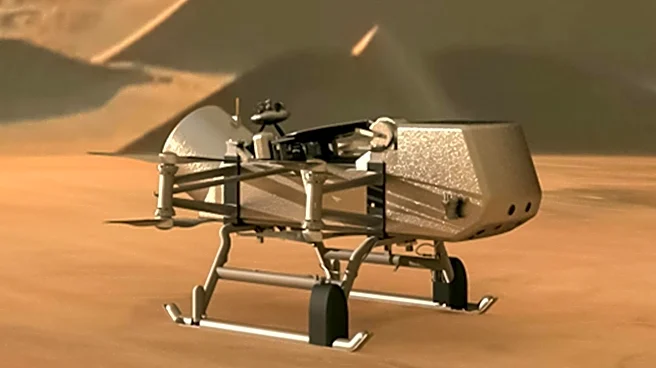
NASA is offering the public an opportunity to send their names to Saturn's largest moon, Titan, aboard the Dragonfly rotorcraft mission. Through the 'Send Your Name with Dragonfly' campaign, individuals can submit their names to be included on a microchip
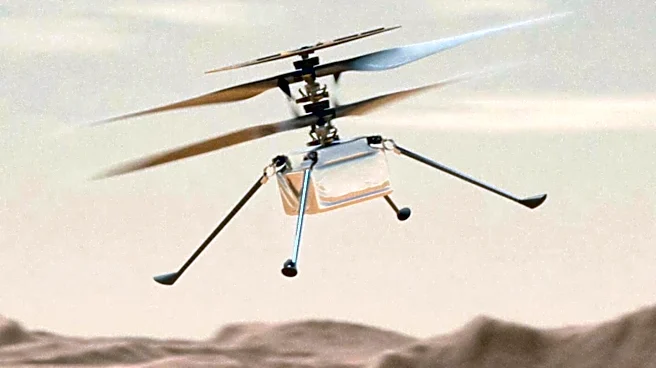
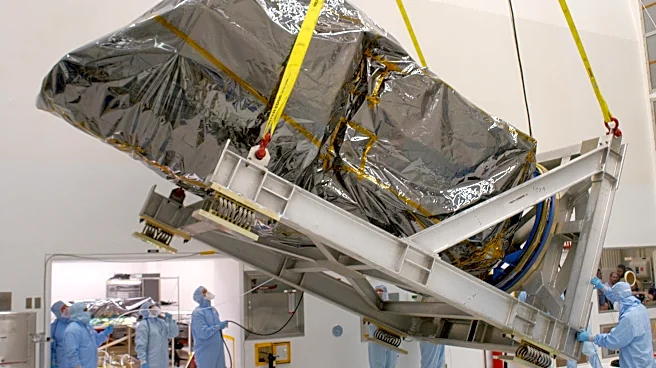
that will travel with the spacecraft. Participants will receive a customized digital boarding pass. The Dragonfly rotorcraft, an eight-rotor flying vehicle, is scheduled for launch in 2028 and is expected to arrive at Titan in 2034. The deadline for name submissions is January 15, 2027, at 11:59 p.m. EST. The spacecraft is currently being assembled and tested at the Johns Hopkins Applied Physics Laboratory (APL) in Laurel, Maryland, where a 'first flight' simulation was recently conducted to test its autonomous flight and landing capabilities.
Why It's Important?
This initiative by NASA serves to engage the public directly in space exploration, fostering interest in science, technology, engineering, and mathematics (STEM) fields across the U.S. and globally. The Dragonfly mission itself is scientifically significant because Titan is the only moon in our solar system with a substantial atmosphere and features that resemble Earth's early environment, including methane lakes and rivers. Exploring Titan could provide crucial insights into the conditions necessary for life and the potential for organic chemistry in extreme environments. The mission's success could advance our understanding of planetary science and astrobiology, potentially influencing future U.S. space exploration priorities and investments in scientific research.
What's Next?
The 'Send Your Name with Dragonfly' campaign will conclude on January 15, 2027, after which the submitted names will be prepared for inclusion on the spacecraft's microchip. The Dragonfly rotorcraft will continue its assembly and testing phases at the Johns Hopkins APL in preparation for its scheduled launch in 2028. Upon arrival at Titan in 2034, the rotorcraft will conduct a 3.3-year mission, flying to various geologically interesting sites, including dunes and Selk Crater, to collect and analyze material samples. The data gathered will be transmitted back to Earth, providing scientists with unprecedented information about Titan's environment and its potential for habitability.
Beyond the Headlines
The Dragonfly mission to Titan represents a bold step in robotic planetary exploration, pushing the boundaries of autonomous flight in an extraterrestrial atmosphere. The choice of a rotorcraft for exploration highlights a growing trend in space missions towards more versatile and mobile platforms, moving beyond traditional landers and rovers. This technological advancement could pave the way for similar aerial exploration of other celestial bodies with atmospheres, such as Venus. Furthermore, the public engagement aspect of sending names to Titan taps into a universal human desire for connection with the cosmos, potentially inspiring a new generation of scientists and engineers and reinforcing the cultural significance of space exploration in the U.S. and worldwide.