




What's Happening?
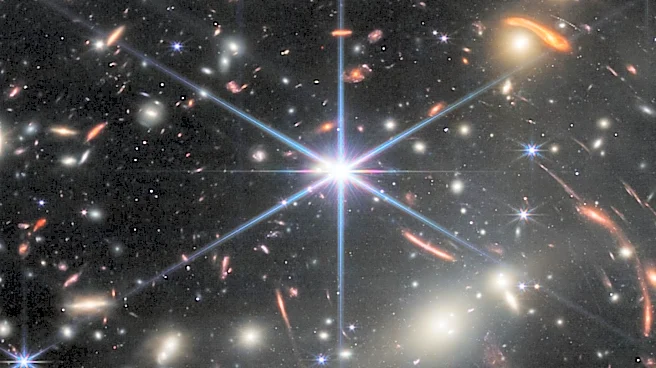
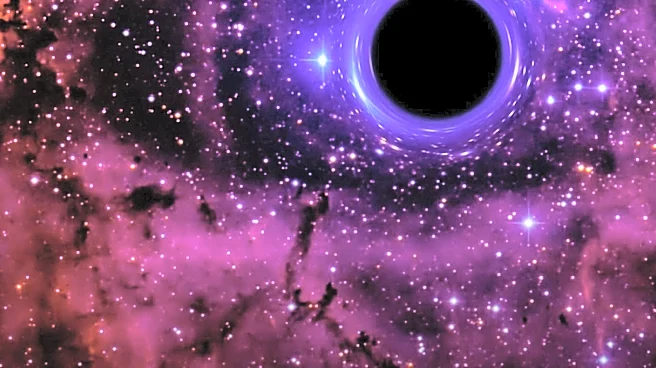
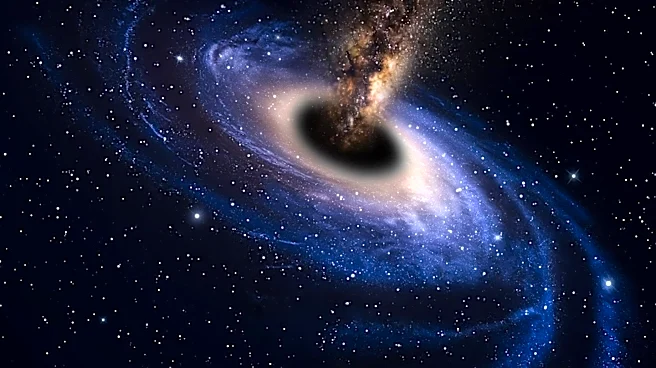
An international team of astronomers, led by specialists from the Max Planck Institute for Extraterrestrial Physics, has discovered three active supermassive black holes within the ancient galaxy J0148-4214. This galaxy is located over 12.5 billion light-years
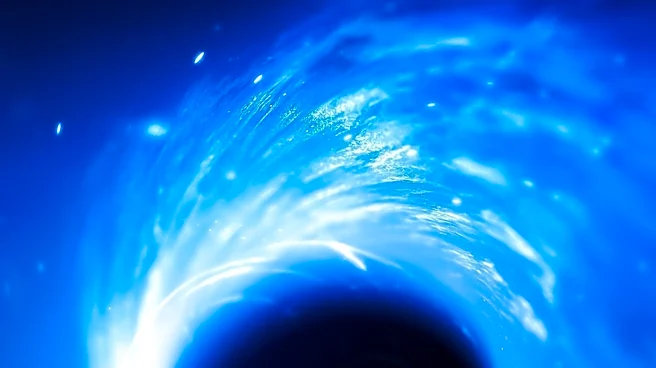
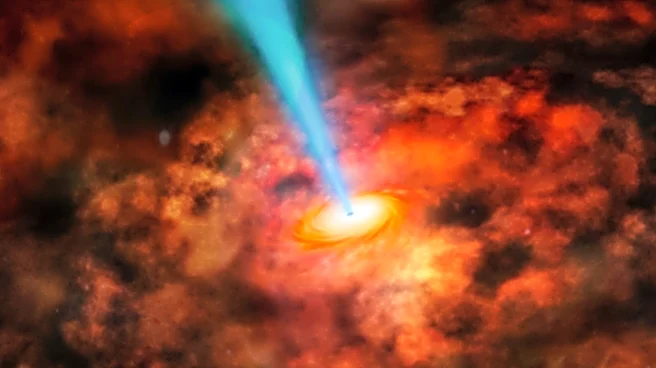
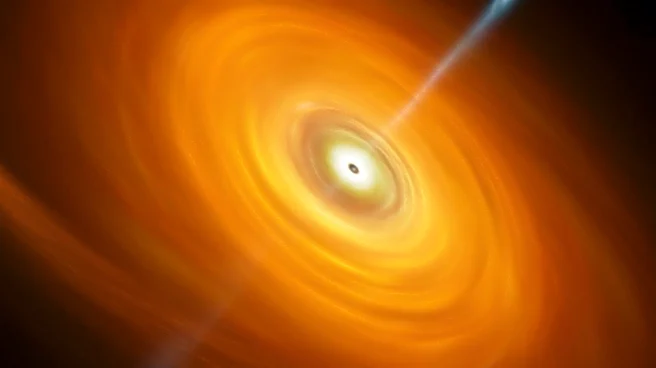
from Earth, meaning scientists are observing it as it was approximately 1.2 billion years after the Big Bang. The findings, published in the journal Astronomy & Astrophysics, reveal that two of these black holes are situated in the central region of the galaxy, about 620 light-years apart, while the third is much further, approximately 5,500 light-years from the center. All three objects are actively accreting surrounding matter, forming rotating disks. The largest black hole has a mass about 80 million times that of the Sun, while the other two are significantly smaller, estimated at 600,000 and 2 million solar masses. Notably, the 600,000 solar mass black hole is growing at a rate exceeding the theoretical Eddington limit, suggesting a faster growth mechanism than basic models predict for the early universe.
Why It's Important?
This discovery is significant because it provides the first evidence of three active black holes coexisting in a single galaxy in the distant universe. The rapid growth rate of one of the black holes, surpassing the Eddington limit, challenges existing models of how supermassive black holes achieved their immense sizes so early in cosmic history. The presence of multiple active black holes in one galaxy suggests that mergers of black holes could have been a more common and rapid pathway for their growth in the early universe. This finding could lead to a re-evaluation of current theories regarding galaxy evolution and the formation of supermassive black holes, indicating that these processes might have been more dynamic and complex than previously understood. Understanding these early universe phenomena is crucial for comprehending the structure and evolution of the cosmos we observe today.
What's Next?
Scientists anticipate that the two black holes in the central region of galaxy J0148-4214 may merge within the next few hundred million years, forming an even more massive object. This potential merger could offer further insights into the rapid growth of black holes in the early universe. The origin of the third, more distant black hole remains a mystery, with hypotheses suggesting it either resulted from a previous merger that imparted an impulse, shifting it away from the center, or that it is gradually moving towards the central region to interact with the other two. Future research will focus on searching for similar systems in other distant galaxies to determine how common such multi-black hole systems are. This will help astronomers reconstruct the history of black hole mergers and gain a better understanding of the mechanisms that allowed supermassive objects to form so early in the universe's existence.
Beyond the Headlines
The detection of three active black holes in a single ancient galaxy, particularly one where a black hole is growing beyond theoretical limits, opens up profound questions about the fundamental physics governing the universe. It suggests that our current understanding of accretion rates and black hole evolution might be incomplete, especially for the extreme conditions of the early cosmos. This discovery could lead to refinements in gravitational wave astronomy, as the mergers of such objects would produce powerful gravitational waves, offering new avenues for observation and study. Furthermore, the existence of multiple black holes in one galaxy could imply a more chaotic and energetic early universe, where galactic interactions and mergers were more frequent and played a crucial role in shaping the distribution of matter and energy. This pushes the boundaries of our cosmological models, urging a deeper exploration into the interplay between dark matter, gas dynamics, and black hole growth in the nascent universe.