







What's Happening?
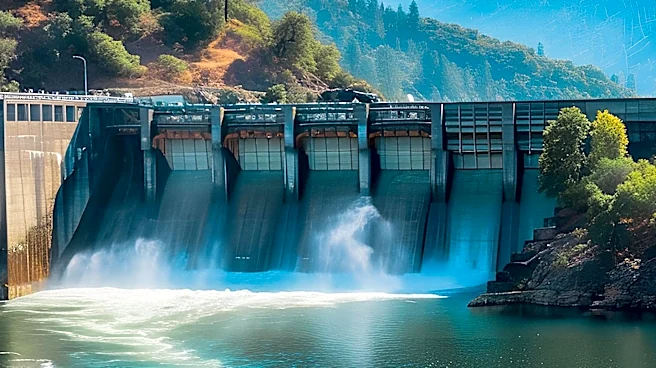
A federal judge has denied Marion County's request for a preliminary injunction to halt the planned drawdown of the Detroit Reservoir. This decision allows the U.S. Army Corps of Engineers to proceed with lowering the reservoir to an elevation of 1,425
feet in 2026, with deeper drawdowns to 1,395 feet planned for subsequent years. The primary goal of these drawdowns is to facilitate the downstream migration of young salmon through the Detroit Dam, as part of federal requirements to aid protected fish populations. However, communities along the North Santiam River, including Stayton and Salem, are concerned about the potential for increased sediment in the water supply, which could impact water treatment facilities, fish habitats, and recreational activities. Marion County has announced its intention to appeal the ruling and seek an emergency injunction, indicating that the underlying lawsuit remains unresolved. The situation draws parallels to the Green Peter Reservoir drawdown, where significant issues arose, including the death of thousands of kokanee salmon due to barotrauma and severe water treatment difficulties caused by sediment, leading to millions in claims for repairs and upgrades from affected communities.
Why It's Important?
The ongoing legal battle and the judge's decision highlight a critical conflict between environmental conservation efforts and community concerns over public infrastructure and natural resources. The Detroit Reservoir drawdown, intended to support salmon migration, could inadvertently jeopardize the drinking water supply for thousands of residents in the North Santiam region. The experience at Green Peter Reservoir serves as a cautionary tale, demonstrating the potential for unforeseen and costly consequences, such as mass fish deaths and significant strain on municipal water treatment systems. If similar issues arise at Detroit Reservoir, it could lead to substantial financial burdens for local governments, potential health risks from compromised water quality, and long-term ecological damage to the river system. This situation underscores the complex challenges of managing large-scale environmental projects, where balancing ecological benefits with human needs and economic impacts is crucial. The outcome of this case could set precedents for how similar environmental mandates are implemented across the U.S., particularly in regions reliant on reservoir systems for water resources.
What's Next?
Marion County plans to appeal the federal judge's decision and will seek an emergency injunction to prevent the Detroit Reservoir drawdown from proceeding as scheduled. This indicates that the legal battle is far from over, and further court proceedings are expected. The U.S. Army Corps of Engineers intends to begin the fish-passage drawdown after November 1 and before December 31, 2026, using forecasts to select optimal conditions. They have stated that water-quality monitoring will guide decisions to modify, pause, or stop operations if downstream drinking-water systems are threatened. Communities like Stayton are preparing for potential problems, despite their treatment systems having managed comparable reservoir levels in the past, and are pursuing additional protections. The deeper drawdown planned for 2027 and beyond remains a significant point of contention in Marion County's legal challenge, which also includes concerns about the Corps' handling of a congressionally required turbidity report. The immediate future will likely involve continued legal maneuvers and close monitoring of water quality as the drawdown commences.
Beyond the Headlines
This situation extends beyond immediate environmental and legal concerns, touching upon broader themes of federal agency accountability, inter-agency coordination, and the long-term sustainability of water resources in the face of climate change and ecological mandates. The dispute highlights the tension between national environmental goals, such as species recovery under federal law, and local community impacts. It raises questions about the adequacy of environmental impact assessments and mitigation strategies when implementing large-scale infrastructure operations. Furthermore, the reliance on historical data (e.g., Detroit reaching 1,425 feet in 2015 and 2019 without reported drinking-water impacts) may not fully account for evolving environmental conditions or cumulative effects. The case could influence future policy decisions regarding dam operations, fish passage requirements, and the allocation of resources for water infrastructure upgrades in communities downstream of major reservoirs. It also underscores the importance of robust public engagement and transparent communication between federal agencies and affected local populations to build trust and find mutually beneficial solutions.