
What's Happening?
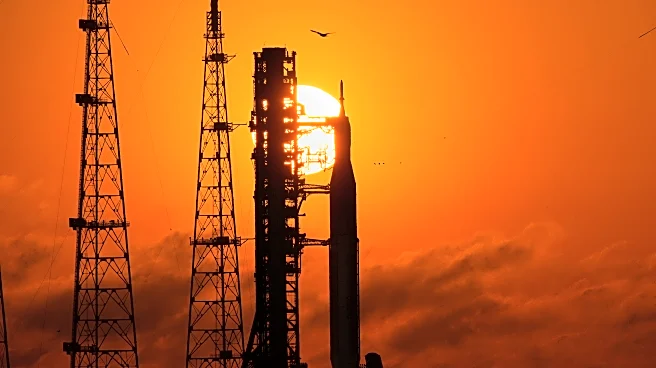
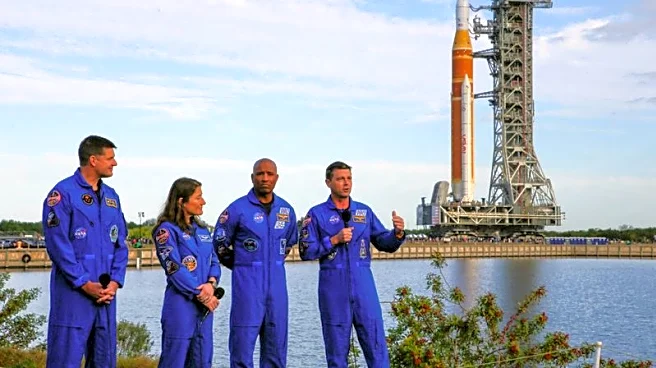
NASA is preparing for the Artemis II mission, which will mark the first time humans have traveled to the moon in over five decades. The mission is set to launch as early as April 1, 2026, and will include a crew of four astronauts: Reid Wiseman, Victor
Glover, Christina Koch, and Jeremy Hansen. This mission is significant as it will be the first time since 1972 that humans will leave Earth's orbit to travel around the moon. The crew is currently engaged in extensive training, including simulations and practice sessions, to prepare for the 10-day mission. The Artemis II mission is a precursor to future missions, including Artemis IV, which aims to land astronauts on the moon by 2028. The mission is not only a technical endeavor but also a symbolic one, representing international collaboration and the potential for humanity to achieve extraordinary feats.
Why It's Important?
The Artemis II mission is a pivotal moment in space exploration, as it signifies a renewed commitment to lunar exploration and the potential for future missions to Mars and beyond. The mission highlights the importance of international collaboration, with Canadian astronaut Jeremy Hansen being part of the crew. This mission also represents a significant step towards diversifying the field of space exploration, with Victor Glover and Christina Koch set to become the first Black person and the first woman, respectively, to travel beyond low Earth orbit. The success of Artemis II could pave the way for more inclusive and collaborative efforts in space exploration, potentially leading to advancements in technology, science, and international relations.
What's Next?
Following the Artemis II mission, NASA plans to continue its Artemis program with subsequent missions aimed at establishing a sustainable human presence on the moon. Artemis IV, scheduled for 2028, will focus on landing astronauts on the lunar surface. The success of these missions could lead to further exploration of Mars and other celestial bodies. The Artemis program also aims to inspire a new generation of scientists, engineers, and explorers, fostering interest in STEM fields and encouraging international cooperation in space exploration.
Beyond the Headlines
The Artemis II mission carries deeper implications beyond its immediate goals. It serves as a reminder of humanity's capacity for innovation and exploration, encouraging a global perspective on scientific and technological progress. The mission also underscores the importance of diversity and representation in space exploration, as it includes astronauts from different backgrounds and nationalities. This diversity can lead to a broader range of perspectives and ideas, ultimately enriching the field of space exploration and contributing to more comprehensive solutions to complex challenges.