





What's Happening?
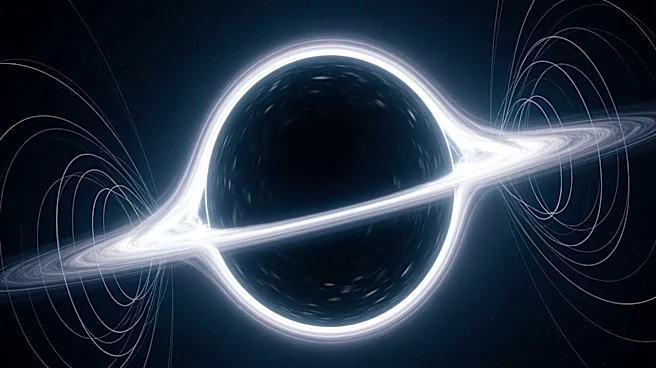
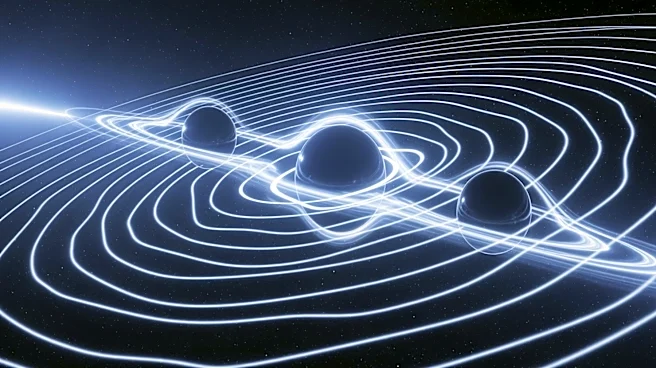
Researchers at the University of Cambridge have conducted numerical simulations suggesting that extremal rotating black holes could form in finite time in vacuum gravity, potentially violating the 3rd law of black hole mechanics. This law states that an extremal black hole,
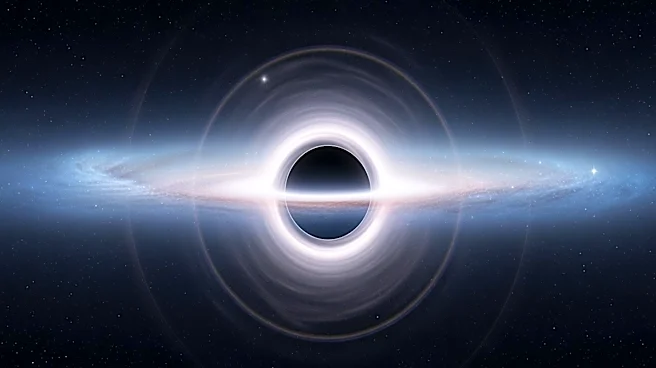
which is spinning or charged to its theoretical limit, cannot form in a finite amount of time. The study, published in Physical Review Letters, indicates that in vacuum gravity, an extremal black hole could emerge from a pre-existing Schwarzschild black hole, challenging long-held assumptions about black hole thermodynamics.
Why It's Important?
This research could reshape fundamental physics theories, particularly those related to black hole mechanics and general relativity. By challenging the 3rd law, the study opens new avenues for understanding the behavior of black holes and their thermodynamic properties. The findings could have implications for theoretical physics and cosmology, potentially influencing how scientists model and interpret cosmic phenomena. The study also highlights the importance of revisiting established scientific assumptions, which can lead to groundbreaking discoveries and advancements in our understanding of the universe.
What's Next?
The researchers plan to conduct further numerical simulations to test the 3rd law of black hole mechanics in four-dimensional vacuum gravity. This endeavor is technically challenging, and it remains uncertain whether the law holds true in this context. If successful, the research could provide new insights into the nature of black holes and the fundamental laws governing the universe. The scientific community may respond with additional studies and experiments to explore the implications of these findings, potentially leading to a deeper understanding of black hole dynamics and their role in the cosmos.