






What's Happening?
Scientists are investigating ambitious geoengineering concepts to mitigate the rapid melting of glaciers and sea ice, a critical consequence of climate change. David Holland, a mathematician and climate researcher at New York University, along with his
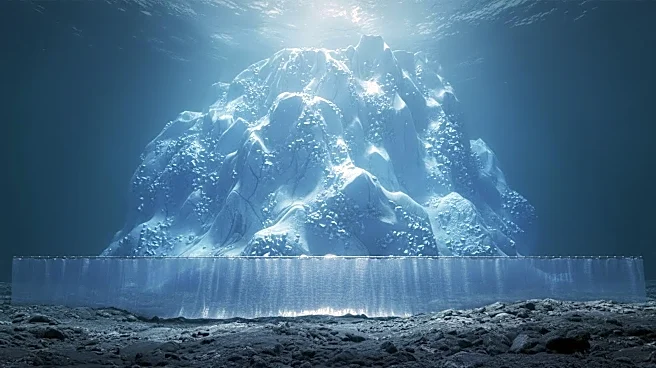
wife Denise Holland, is conducting fieldwork on Greenland's Jakobshavn Glacier and Antarctica's Thwaites Glacier. These glaciers are among the fastest-melting on Earth, contributing significantly to global sea level rise. The Hollands are gathering extensive data using radar, seismic sensors, drones, weather stations, and satellites to better understand the mechanisms of glacial retreat. A particularly audacious idea being explored is the feasibility of an underwater barrier, or 'sea curtain,' to block warm ocean currents from reaching and melting glaciers from below. This concept is being tested with robotic moorings in an undersea canyon near the Thwaites Glacier, which is the size of Florida and holds enough water to raise global sea levels by up to 10 feet.
Why It's Important?
The exploration of geoengineering solutions for melting glaciers is critically important due to the undeniable and accelerating impact of climate change on global sea levels. The rapid retreat of glaciers like Jakobshavn and Thwaites poses a significant threat to coastal communities worldwide, potentially leading to widespread displacement, infrastructure damage, and ecological disruption. Traditional climate change mitigation efforts, primarily focused on reducing fossil fuel consumption, may not be sufficient to prevent catastrophic sea level rise in the short to medium term. Therefore, investigating more direct, large-scale interventions like underwater barriers could offer a supplementary approach to stabilize these critical ice masses. Success in such endeavors could buy valuable time for societies to adapt and for global emissions reductions to take full effect, potentially averting some of the most severe consequences of climate change. However, these interventions also carry potential risks and ethical considerations that require careful study.
What's Next?
The immediate next step for David and Denise Holland is to continue collecting and analyzing data from their fieldwork in Greenland and Antarctica. The robotic moorings deployed near the Thwaites Glacier will provide crucial information on warm water depth and ocean current strength, which is essential for determining the feasibility of an underwater barrier. This data will inform future decisions on whether such an engineering solution is viable. While critics, such as Rob Larter of the British Antarctic Survey, express skepticism about the practicality and potential adverse consequences of geoengineering ideas, Holland emphasizes that the current focus is on data collection to inform future choices. The broader scientific community will continue to debate the ethical, ecological, and geopolitical implications of geoengineering, alongside ongoing efforts to reduce greenhouse gas emissions. The findings from the Hollands' research will contribute significantly to this global discussion on how to address the urgent challenges posed by melting glaciers.
Beyond the Headlines
The pursuit of geoengineering solutions for glaciers highlights a profound shift in humanity's approach to climate change, moving beyond mitigation and adaptation to considering direct intervention in Earth's natural systems. This raises complex ethical and governance questions: Who decides when and where to deploy such technologies? What are the unforeseen ecological consequences of altering massive natural processes? The concept of a 'sea curtain' for glaciers, while seemingly localized, could have ripple effects on ocean currents, marine ecosystems, and weather patterns far beyond the immediate intervention site. This also underscores a growing tension between technological optimism—the belief that human ingenuity can solve environmental crises—and the precautionary principle, which advocates for caution in the face of potential irreversible harm. The debate over geoengineering forces a re-evaluation of humanity's relationship with nature and the extent to which we are willing to engineer our planet to counteract the effects of our own actions.