




What's Happening?
Physicist Savvas Koushiappas from Brown University in the U.S. has published a new paper in Physical Review D, proposing an alternative explanation for the Universe's accelerating expansion. Instead of solely relying on dark energy, Koushiappas suggests
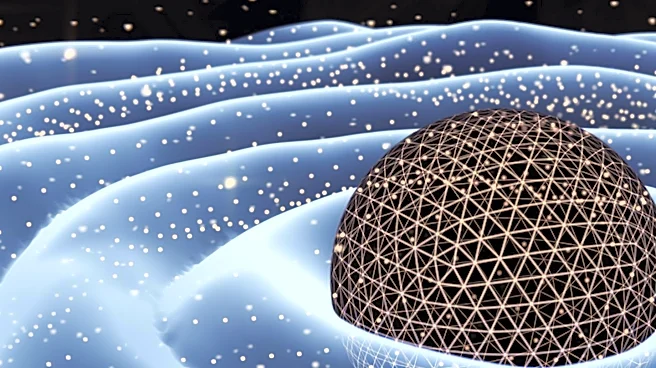
that this acceleration could be a macroscopic imprint of an irreducible quantum uncertainty in simultaneously knowing the size and expansion rate of the Universe. This model applies a classic quantum rule—that certain pairs of properties cannot be precisely known at the same time—to the entire Universe. He posits that this quantum modification to the geometry of the Universe itself could account for some of the phenomena typically attributed to dark energy, which currently accounts for roughly 68 percent of the Universe's energy density in the standard cosmological model.
Why It's Important?
This research is significant because it offers a potential breakthrough in one of the most challenging problems in modern physics: reconciling general relativity with quantum mechanics. The standard cosmological model struggles to fully explain dark energy and its implications for the Universe's expansion. Koushiappas's proposal suggests that the accelerating expansion might not require an unknown material component like dark energy but could instead stem from fundamental quantum-gravitational physics. If validated, this could fundamentally alter our understanding of the Universe's evolution and the nature of dark energy, shifting the focus from an unknown substance to a modification of cosmic geometry. It also provides a potential observable signature of quantum-gravitational physics, which has been largely theoretical, offering new avenues for empirical testing through astronomical observations.
What's Next?
Koushiappas's model, while offering compelling solutions, acknowledges that inconsistencies and open questions remain. The next steps involve further calculations and, crucially, additional observations of deep space to test these new ideas. Upcoming surveys from projects like DESI, Euclid, and the Vera C. Rubin Observatory are expected to provide more precise measurements of the Universe's expansion history. These measurements could either support or challenge Koushiappas's hypothesis, helping to determine if the observed expansion history is consistent with the simplest standard cosmological model or if it indeed carries a signature of quantum-gravitational physics. The research also outlines an alternative configuration that could resolve issues around the Big Bang singularity, suggesting the Universe might have originated from a rebound of an earlier, contracting Universe, which also requires further investigation.
Beyond the Headlines
The implications of Koushiappas's theory extend beyond astrophysics, touching upon the philosophical underpinnings of our understanding of reality. By proposing that quantum uncertainty operates at a cosmic scale, the research challenges the classical deterministic view of the Universe. It suggests that the very fabric of spacetime might be inherently quantum, influencing large-scale phenomena in ways previously unimagined. This could lead to a paradigm shift in cosmology, where the search for dark energy as a mysterious substance might be re-directed towards understanding the quantum nature of gravity itself. Such a shift would not only unify two major branches of physics but also offer a more elegant and integrated picture of the cosmos, potentially revealing a deeper, more fundamental layer of reality that governs everything from the smallest particles to the largest structures in the Universe.