






What's Happening?
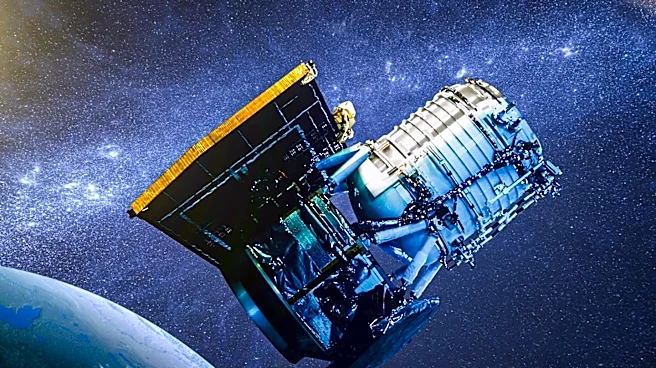
Katalyst Space Technologies is encountering significant challenges with its Link spacecraft, which was launched to save NASA's Swift gamma-ray telescope from reentry. The spacecraft is experiencing attitude control issues, causing it to spin and lose
communication intermittently. Two of the three reaction wheels, crucial for maintaining the spacecraft's orientation, are not functioning, and the cold gas thruster system is partially operational. The mission, which began on July 3, aims to attach the Link satellite to Swift using robotic arms and raise its orbit with electric thrusters. Without intervention, Swift is expected to reenter Earth's atmosphere and burn up within months. The mission is critical as Swift is one of the few observatories capable of detecting gamma-ray bursts, and NASA has invested $30 million in this rescue effort.
Why It's Important?
The success of this mission is vital for NASA's continued ability to study gamma-ray bursts, which are among the most powerful explosions in the universe. The failure of the Link spacecraft could result in the loss of the Swift observatory, impacting scientific research and data collection. This mission also represents a significant investment in commercial space technology, highlighting the growing role of private companies in supporting government space initiatives. The challenges faced by Katalyst Space Technologies underscore the complexities and risks associated with space missions, particularly those involving satellite servicing and orbit adjustments.
What's Next?
Katalyst Space Technologies is working to stabilize the Link spacecraft using its electric thrusters, which were not originally intended for this purpose. The company plans to update the spacecraft's guidance, navigation, and control systems to accommodate its current configuration. If successful, these adjustments will allow the mission to proceed with its approach to Swift. The outcome of these efforts will determine whether the mission can continue as planned, with the potential to set a precedent for future satellite servicing missions.