
What's Happening?
A significant community debate is unfolding within New York City's Community Board 2 regarding the renovation of the closed Dapolito Center on Clarkson Street and the development of a new recreation center at 388 Hudson Street. During a recent Parks and Waterfront
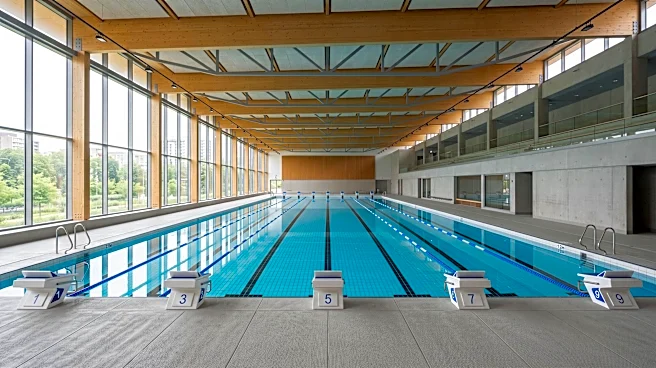
Committee meeting, community members, led by Andrew Berman of Village Preservation, pushed to discuss the Dapolito Center's renovation despite the agenda focusing solely on the new 388 Hudson Street facility. The Parks Department initially planned to renovate Dapolito, but a closer inspection revealed that the 120-year-old building would be more difficult and expensive to upgrade, potentially failing to meet ADA accessibility standards. The department now proposes demolishing Dapolito and building a new, state-of-the-art recreation center at 388 Hudson, which would include an indoor pool and a larger basketball court. Additionally, plans are underway to renovate and enlarge the outdoor pool next to the Dapolito site. This has led to a contentious discussion about resource allocation and community needs.
Why It's Important?
This situation highlights critical issues in urban planning, resource allocation, and community engagement within New York City. The debate over the Dapolito Center and the new 388 Hudson Street facility underscores the challenges faced by city agencies in balancing historical preservation with modern needs and budget constraints. The Parks Department, operating with a limited budget, aims to distribute services equitably across the city's 59 community boards. Community Board 2, identified as one of the city's wealthiest and most politically powerful neighborhoods, already possesses an above-average level of park services. The demand for two state-of-the-art recreation centers within one block, as advocated by some Dapolito supporters, raises questions about equitable distribution of public funds and potential institutional biases in resource allocation. This conflict could set a precedent for how similar urban development projects are handled in other communities, particularly concerning the trade-offs between renovating older structures and building new, more compliant facilities.
What's Next?
The immediate next steps involve continued community discussions and potential negotiations between the Parks Department and Dapolito supporters. A proposed compromise, suggested by former CB2 member Tobi Bergman, involves demolishing the main Dapolito building as planned and converting the land into new open space parkland. This would create a park stretching from Varick to Hudson streets, incorporating existing ball/soccer fields, a small playground, and the renovated outdoor pool, possibly with a renovated Dapolito facade serving as a grand entrance. This proposal aims to address the community's need for open green space, a concern previously highlighted during the debate over the Elizabeth Street Garden. The outcome will likely depend on the willingness of Dapolito supporters to compromise and embrace a solution that balances historical sentiment with practical urban planning and equitable resource distribution.
Beyond the Headlines
Beyond the immediate dispute, this situation touches upon deeper themes of institutional racism and urban equity. The article suggests that the demand for multiple high-end recreational facilities in an already well-served, affluent neighborhood, while other areas of the city may lack basic amenities, could be seen as an example of institutional racism. This is not attributed to personal prejudice but rather to policies and priorities that inadvertently favor privileged segments of society. The debate forces a critical examination of how city resources are allocated and whether current practices perpetuate disparities. It also highlights the tension between preserving historical structures, which often carry significant community sentiment, and the practicalities of modern urban development, including accessibility requirements and cost-effectiveness. The resolution of this conflict could influence future policy decisions regarding urban renewal, community development, and the equitable distribution of public services across diverse neighborhoods in New York City.