






What's Happening?
Republican U.S. Representative Nick Begich III has secured the leading position in Alaska's primary election for the U.S. House, according to preliminary results. With most precincts reporting, Begich garnered approximately 46% of the vote. He is seeking
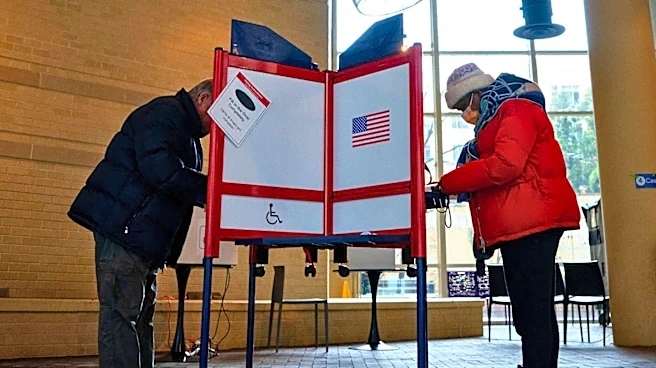
a second term and is one of 15 candidates on the ballot. Independent candidate Bill Hill is trailing with about 31% of the early vote, while Democrat Matt Schultz, who suspended his campaign in mid-July, still received around 8% of primary votes. Another Democrat, Eric Hafner, an inmate at a federal prison, was in fourth place with just under 4% of the vote. Begich's campaign has raised significant funds, totaling $5.4 million by the end of July, compared to Hill's $1.3 million. The top four candidates from the primary will advance to the November general election under Alaska's election system.
Why It's Important?
This primary outcome is significant for the Republican Party's efforts to maintain or expand its representation in the U.S. House, particularly in a state like Alaska, which has a unique political landscape. Nick Begich III's strong performance, despite his family's prominent Democratic roots, highlights a potential shift or consolidation of Republican support in the state. His substantial fundraising advantage over other candidates suggests a well-resourced campaign, which could be a critical factor in the general election. The advancement of the top four candidates, regardless of party affiliation, to the November election under Alaska's open-primary/ranked-choice system, means that the general election will likely feature a diverse set of political ideologies, making the final outcome less predictable and potentially more competitive. This system also allows for broader voter participation, as most voters in Alaska are politically unaffiliated.
What's Next?
The preliminary results indicate that Nick Begich III, Bill Hill, and potentially Matt Schultz and Eric Hafner, will advance to the November general election for the U.S. House. Ballot counting is expected to continue through August 28, the deadline for mailed absentee ballots to reach the Alaska Division of Elections. Candidates who finish in the top four have until August 31 to decide whether to remain in the race or withdraw. In past elections, some high-finishing candidates have withdrawn to consolidate party support, a strategy that could be considered again this year. The general election will then determine who ultimately represents Alaska in the U.S. House, with the ranked-choice voting system potentially playing a crucial role in the final outcome.
Beyond the Headlines
The political dynamics in Alaska, particularly the success of a Republican like Nick Begich III from a family with deep Democratic ties, underscore the evolving nature of party affiliations and voter preferences in the state. His uncle, Tom Begich, a Democratic candidate for governor, and his nephew, a Republican U.S. Representative, even campaigned on opposite street corners, illustrating the complex and sometimes familial divisions within Alaskan politics. This situation reflects a broader trend where individual candidates' platforms and appeal can sometimes transcend traditional party lines, especially in states with unique electoral systems like Alaska's open primary and ranked-choice general election. The significant voter turnout, inching towards near-record levels, also suggests a highly engaged electorate keenly interested in the direction of their state and federal representation.