






What's Happening?
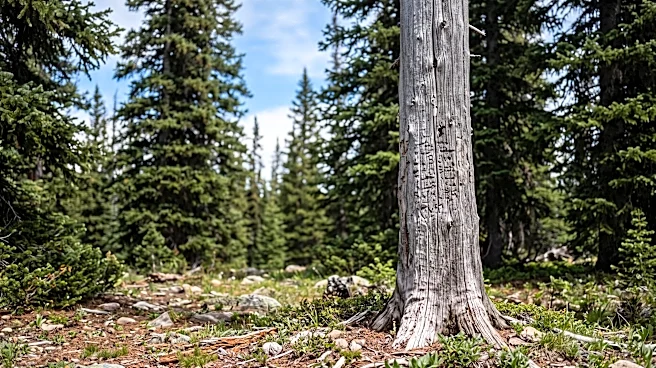
Public opposition has successfully delayed the U.S. Forest Service's plan to remove a historic tree from the Washakie Wilderness in the Shoshone National Forest. The dead Engelmann spruce, located about 28 miles from the nearest trailhead, bears inscriptions
from surveyors who mapped the Yellowstone Forest Reserve in 1893. Plans to recover the tree via helicopter for display at the Wyoming State Museum and later the Buffalo Bill Center of the West Museum had been underway for years. However, federal land managers did not initially involve the public or advocacy groups. After learning of the project, Wilderness Watch, a Montana-based advocacy group, encouraged public comments, leading to hundreds of emails to Shoshone National Forest Supervisor Ken Coffin. In response to these concerns, Coffin paused the project, ensuring the tree will not be removed in 2026. Discussions are now underway with Wyoming State Parks to potentially create a 3D replica of the tree instead of removing the original.
Why It's Important?
This delay underscores the significant influence of public advocacy in shaping land management decisions within designated wilderness areas. The project raised concerns about the use of mechanical equipment, such as helicopters, and the removal of natural elements from a wilderness setting, which is intended to remain untrammeled. The tree, while historically significant, also serves an ecological role as a snag, providing habitat and nutrients to the forest ecosystem. The public's pushback highlights a strong desire to uphold the principles of the Wilderness Act, which prioritizes preserving natural conditions. This outcome also emphasizes the need for transparency and public engagement in decisions affecting national wilderness areas, ensuring that diverse perspectives are considered before irreversible actions are taken.
What's Next?
The Shoshone National Forest is currently in talks with Wyoming State Parks to explore the feasibility and acceptability of using a 3D scan to create a replica of the inscribed tree. If this alternative satisfies the project proponents, including Wyoming State Parks, the original tree may remain in the Washakie Wilderness permanently. However, if the proponents are not appeased by the 3D replica plan, the Forest Service could resume its approval process for removing the tree. Wilderness advocates will likely remain vigilant, continuing to advocate for the tree to stay in its natural environment. This situation could set a precedent for how historical artifacts within wilderness areas are managed, potentially favoring non-invasive documentation methods over physical removal.
Beyond the Headlines
The debate surrounding this historic tree touches upon fundamental questions about the purpose and management of wilderness areas. Is a wilderness primarily a place for ecological preservation, or can it also serve as a repository for historical artifacts that might be better preserved and interpreted in a museum setting? The public's strong reaction suggests a prevailing view that the integrity of the wilderness environment should take precedence. This incident also highlights the evolving role of technology, such as 3D scanning, in bridging the gap between preservation and accessibility, offering new ways to appreciate historical elements without disturbing their natural context. It prompts a broader discussion on how to balance the intrinsic value of wilderness with the educational and cultural value of historical markers found within these protected landscapes.