






What's Happening?
Astronomers have identified IRAS 18293−0941 as the Milky Way's first confirmed microblazar, a miniature version of the powerful cosmic objects found at the centers of distant galaxies. This system consists of a black hole, estimated to be about ten times
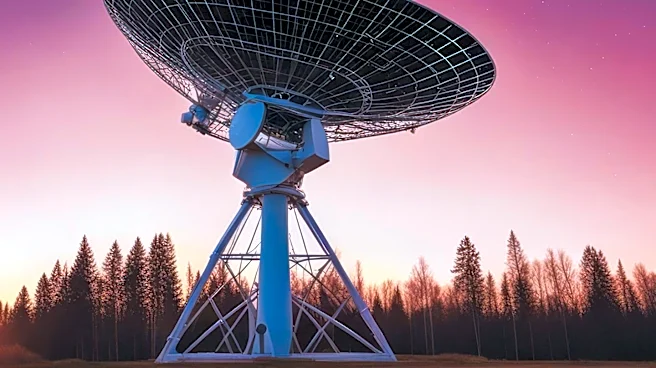
the mass of the sun, actively siphoning material from a massive companion star. As this material forms a swirling disk around the black hole, powerful magnetic fields launch two opposing jets into space. One of these jets is pointed almost directly towards Earth, carrying matter at approximately 75% the speed of light, while the other impacts an enormous cloud of interstellar gas in the opposite direction. The object, initially detected in 1983 by the Infrared Astronomical Satellite (IRAS), remained largely unstudied due to obscuring interstellar dust. An international team, led by Josep Martí of the University of Jaén in Spain, used the European VLBI Network and data from the European Space Agency’s Gaia spacecraft to confirm the jet's origin within the stellar system.
Why It's Important?
The discovery of IRAS 18293−0941 is significant because it provides a unique, close-up opportunity to study the mechanisms of blazars, which are typically found in distant galaxies. Microblazars operate on the same fundamental principles as their supermassive counterparts but on a much smaller scale, making them ideal laboratories for detailed observation and analysis. This proximity allows astronomers to study the structure and evolution of these powerful systems with unprecedented clarity. Crucially, this discovery could help solve a long-standing astronomical mystery: the origin of some of the most energetic particles in our galaxy. The powerful jets emitted by microblazars are prime candidates for accelerating these cosmic rays, and studying IRAS 18293−0941 could provide direct evidence for this process, enhancing our understanding of high-energy astrophysics within our own galaxy.
What's Next?
The confirmation of IRAS 18293−0941 as a microblazar will undoubtedly lead to extensive follow-up observations and research. Astronomers will likely focus on studying the system's structure, the dynamics of its accretion disk, and the properties of its relativistic jets in greater detail. This will involve continued use of advanced radio telescopes and potentially other observational instruments to gather more data on the system's behavior and its interaction with the surrounding interstellar medium. The goal will be to understand how these jets are launched, how they accelerate particles to such high energies, and their precise contribution to the cosmic ray population in the Milky Way. This research could also inform our understanding of supermassive blazars and the energetic processes occurring in the centers of other galaxies.
Beyond the Headlines
The existence of a microblazar in our own galaxy offers a tangible link to the extreme phenomena observed in the distant universe. It underscores the idea that the fundamental physics governing black holes and their energetic outflows are universal, regardless of scale. This discovery could bridge the gap between theoretical models of particle acceleration and direct observational evidence, providing a clearer picture of how the most energetic particles in the cosmos are generated. Furthermore, it highlights the ongoing process of discovery within our own galactic neighborhood, demonstrating that even after decades of observation, the Milky Way still holds profound secrets. The ability to study such a powerful system relatively close to Earth could revolutionize our understanding of high-energy astrophysics and the energetic landscape of our galaxy.