
What's Happening?
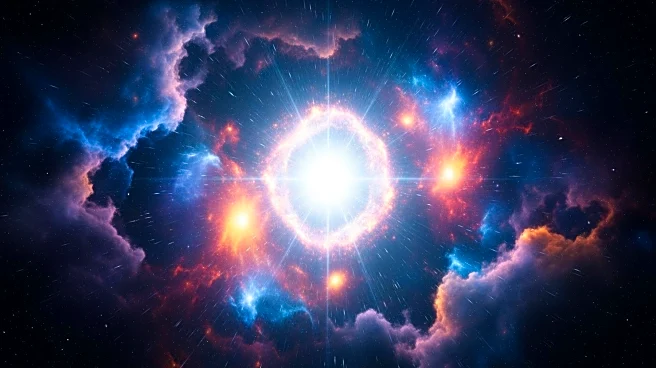
The first second of the universe's existence is highlighted as a pivotal moment in cosmological history. During this time, the universe expanded from an infinitely small point to a vast cosmos, driven by a rapid inflationary period. This expansion laid
the groundwork for the formation of the universe's large-scale structures. Quantum fluctuations during this period led to variations in density, which eventually resulted in the formation of stars and galaxies. The separation of fundamental forces and the formation of the first particles occurred within this brief timeframe, setting the stage for the universe's evolution.
Why It's Important?
Understanding the first second of the universe is crucial for cosmologists as it provides insights into the fundamental processes that shaped the cosmos. The rapid expansion and subsequent cooling allowed for the formation of matter and the separation of forces, which are essential for the universe's current structure. This period also highlights the role of quantum mechanics in creating the initial conditions for cosmic evolution. By studying this moment, scientists can better understand the origins of the universe and the forces that govern it.
Beyond the Headlines
The first second of the universe's existence raises questions about the nature of time and space, as well as the role of quantum mechanics in cosmic evolution. The rapid inflation and subsequent phase transitions challenge our understanding of physics and the universe's initial conditions. This period also underscores the interconnectedness of fundamental forces and particles, which continue to influence the universe's behavior. As research progresses, new theories may emerge to explain the complexities of this critical moment in cosmological history.