







What's Happening?
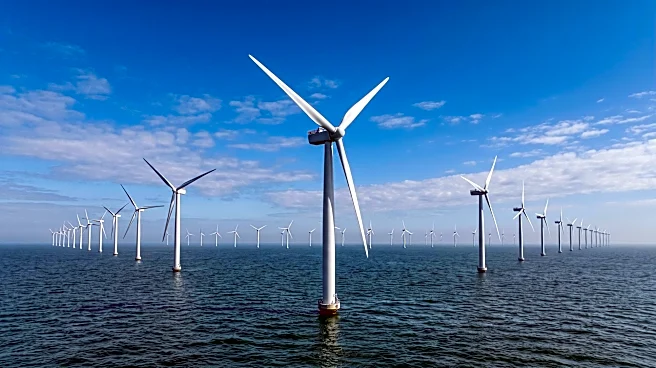
The Revolution Wind offshore wind project, a $6.2 billion joint venture between Ørsted and Skyborn Renewables, has completed the installation of all 65 turbines in Rhode Island Sound. This milestone was achieved despite facing two stop-work orders issued
by the Trump administration. The project, located approximately 15 miles south of Little Compton, Rhode Island, began delivering partial power to the grid in March and is expected to reach full commercial operation later this year. Once fully operational, its 65 Siemens Gamesa turbines will produce up to 704 megawatts of electricity, with 400 MW allocated to Rhode Island and 304 MW to Connecticut, enough to power over 350,000 homes. This marks Revolution Wind as the third large-scale offshore wind farm to complete construction in southern New England waters, following Vineyard Wind off Massachusetts and South Fork Wind serving Long Island.
Why It's Important?
The completion of the Revolution Wind project is a significant development for renewable energy infrastructure in the United States, particularly for New England. It represents a substantial step towards diversifying the region's energy supply and reducing reliance on fossil fuels. The project's capacity to generate 704 megawatts of clean energy will contribute to grid stability and help meet growing electricity demands in Rhode Island and Connecticut. Furthermore, an analysis by Connecticut’s Department of Energy and Environmental Protection projected that Revolution Wind could save New England ratepayers up to $500 million annually in wholesale energy costs. The successful completion, despite federal opposition, underscores the resilience of offshore wind developers and state-level commitment to renewable energy goals, potentially influencing future energy policy and investment in the sector.
What's Next?
With all turbines installed, Revolution Wind will now focus on commissioning activities, with full commercial operation anticipated by the end of the year. This will involve bringing the entire 704-megawatt capacity online, providing a significant boost to the power grids of Rhode Island and Connecticut. The project's success may encourage further investment and development in the U.S. offshore wind sector, despite ongoing political challenges. State governments in the Northeast, which have strong decarbonization goals, will likely continue to champion such projects. The operational performance of Revolution Wind, particularly during peak demand periods, will be closely watched as a case study for the reliability and economic benefits of large-scale offshore wind in the U.S.
Beyond the Headlines
The journey of the Revolution Wind project highlights the complex interplay between federal policy, state energy goals, and private investment in the renewable energy sector. The Trump administration's attempts to halt construction, citing national security concerns, underscore the political headwinds faced by large-scale renewable projects. The project's ability to overcome these challenges through legal means demonstrates the importance of judicial oversight in environmental and energy policy. This case also sets a precedent for how future renewable energy projects might navigate potential federal opposition, emphasizing the critical role of state-level advocacy and legal challenges. The continued development of offshore wind, despite such obstacles, signals a long-term shift in the U.S. energy landscape towards cleaner sources, driven by both environmental imperatives and economic benefits for ratepayers.