



What's Happening?
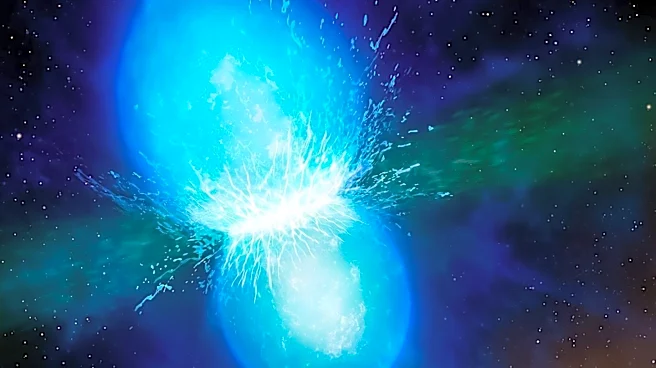
A new study investigates the behavior of a newborn neutron star (NS) following a binary neutron star (BNS) merger. This NS injects rotational energy into the surrounding ejecta, creating a radiation-dominated plasma known as a Wien fireball. This fireball is characterized
by extremely high densities of electrons, positrons, and photons, leading to saturated Comptonization where photons and pairs reach a common temperature. The research focuses on how a 'polar funnel,' created by a relativistic jet propagating through the ejecta, influences the energy transport and leakage from this nebula. This funnel allows energy to escape, rather than being solely diffused through the ejecta or lost through adiabatic expansion. The study numerically integrates equations to model the energy, pair, and photon evolution within this system, considering different magnetic field strengths of the post-merger NS and varying funnel opening angles. The findings suggest that funnel leakage can significantly exceed adiabatic loss at early times, especially for larger funnel areas.
Why It's Important?
This research is crucial for understanding the complex phenomena associated with binary neutron star mergers, which are multi-messenger sources producing gravitational waves, short gamma-ray bursts (GRBs), and kilonovae. The model's prediction of quasi-thermal components in the extended emission of short GRBs, originating from the funnel leakage of the Wien fireball, offers a potential explanation for observations in events like GRB 211211A and GRB 230307A. These thermal signatures, persisting for tens to hundreds of seconds, are longer than typical prompt GRB emissions and challenge conventional explanations. By providing a mechanism for these extended thermal emissions, the study contributes to a more complete picture of the energy dissipation and radiative processes in the aftermath of BNS mergers. This improved understanding can refine models for kilonovae and GRB afterglows, ultimately enhancing our interpretation of these powerful cosmic events.
What's Next?
The study's findings suggest that future observations of short GRBs should specifically look for quasi-thermal components in their extended emission, as these could serve as direct evidence for the Wien fireball and funnel leakage mechanism. Further research could involve more sophisticated numerical simulations that incorporate additional physical processes or explore a wider range of initial conditions for the neutron star and ejecta. Refining the models for the acceleration and interaction of the outflow with the GRB jet will also be important for a comprehensive understanding. Additionally, continued multi-messenger astronomy efforts, combining gravitational wave detections with electromagnetic observations, will be vital to test and validate these theoretical predictions, potentially leading to a deeper understanding of the fundamental physics governing neutron star mergers and their observable consequences.
Beyond the Headlines
The concept of a 'Wien fireball' and its 'funnel leakage' offers a fascinating glimpse into the extreme physics at play in the universe's most energetic events. Beyond explaining specific GRB observations, this research highlights the intricate interplay between magnetic fields, relativistic jets, and dense plasma in shaping the radiative output of cosmic phenomena. The persistence of the Compton y parameter above unity for longer durations due to funnel leakage implies that the thermal phase of these fireballs is more prolonged than previously thought, influencing the spectral characteristics of the emitted radiation. This work underscores the importance of considering anisotropic ejecta distributions and the role of jet-induced structures in accurately modeling the aftermath of BNS mergers, moving beyond simplified isotropic assumptions. It also opens avenues for exploring how similar mechanisms might operate in other astrophysical contexts involving highly magnetized, rapidly rotating compact objects.