






What's Happening?
Researchers have uncovered new insights into the evolution of crabs' distinctive sideways movement, tracing it back to a common ancestor from approximately 200 million years ago. The study, published in eLife, analyzed the locomotion of 50 species of true
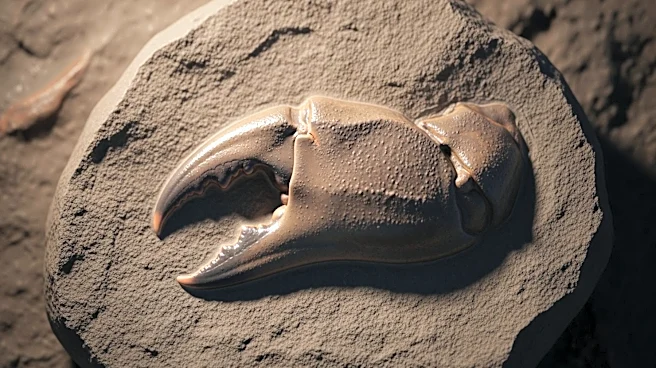
crabs, revealing that sideways walking likely evolved once in the evolutionary history of crabs. This movement style, which is a hallmark of the Brachyura group, offers significant advantages such as unpredictable movement patterns that help evade predators. The research team, led by Yuuki Kawabata from Nagasaki University, used video recordings and phylogenetic data to map the evolutionary trajectory of crab locomotion. The findings suggest that while body shapes in crabs have evolved multiple times, the behavioral trait of sideways walking is a rare evolutionary innovation.
Why It's Important?
The discovery of the evolutionary origins of crabs' sideways movement provides valuable insights into animal locomotion and evolutionary biology. This trait has likely contributed to the ecological success of true crabs, allowing them to thrive in diverse environments, from terrestrial to deep-sea habitats. Understanding such evolutionary innovations can help scientists comprehend how certain traits contribute to species' survival and adaptation. The study also highlights the interplay between biological innovations and environmental changes, as the emergence of sideways walking coincided with significant geological events that created new ecological niches.
What's Next?
Future research may focus on further analyzing the role of environmental factors in the evolution of crab locomotion. Scientists could explore trait-dependent diversification and conduct performance tests to link sideways movement to adaptive advantages. Additionally, fossil records and timelines could provide deeper insights into how environmental changes influenced the diversification of true crabs. Such studies could expand the understanding of how evolutionary innovations arise and persist, offering broader implications for the study of animal movement and adaptation.
Beyond the Headlines
The study of crabs' sideways movement also raises questions about the constraints and opportunities in evolutionary biology. While the trait is rare, its success in true crabs suggests that certain innovations can open new adaptive opportunities. However, these innovations are often constrained by phylogenetic history and ecological contexts. This research underscores the complexity of evolutionary processes and the need for comprehensive analyses to understand the factors driving species diversification and adaptation.