
What's Happening?
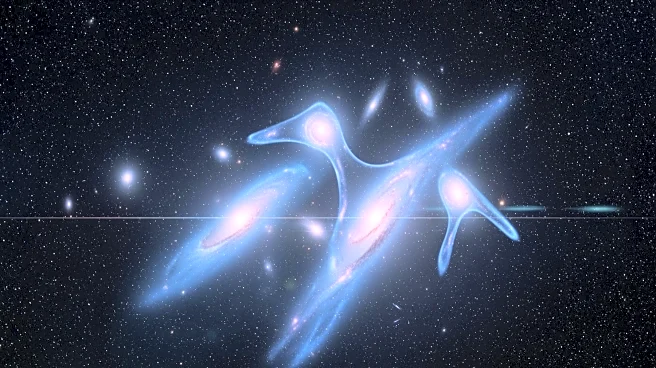
The James Webb Space Telescope (JWST) has identified nine unusual cosmic objects that exhibit characteristics of both stars and galaxies, leading researchers to nickname them 'platypus' galaxies. These objects, initially appearing as stars, revealed more
galaxy-like features upon further examination. Haojing Yan, an astronomer at the University of Missouri, presented these findings at the American Astronomical Society meeting. The objects are slightly larger than typical point sources and exhibit narrow emission lines indicative of active star formation, a trait usually associated with galaxies. Researchers are exploring whether these objects could be a new class of active galactic nuclei (AGN) or young star-forming galaxies.
Why It's Important?
This discovery could provide new insights into the early stages of galaxy formation and the behavior of galaxies in the universe's infancy. Understanding these 'platypus' galaxies may help astronomers refine models of galaxy evolution and the role of AGNs. The findings challenge existing classifications and suggest the presence of previously unknown cosmic phenomena. This could have significant implications for our understanding of the universe's structure and the processes that govern galaxy formation.
What's Next?
Researchers plan to conduct further observations with the JWST to identify more examples of these objects and determine their nature. The goal is to ascertain whether they represent a new form of AGN or a unique type of star-forming galaxy. Continued study may reveal more about the processes occurring in these objects and their potential impact on our understanding of cosmic evolution.