
What's Happening?
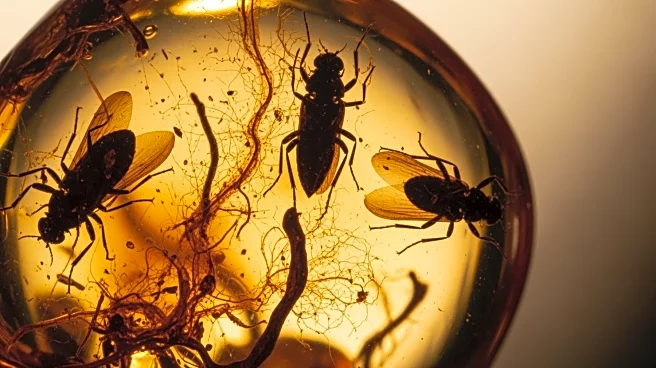
Scientists have discovered fossilized insects in 99-million-year-old amber that show evidence of parasitic fungi. The fossils, found in Myanmar, include a fly and an ant, each infected by a different species
of fungus. These fungi, identified as Paleoophiocordyceps ironomyiae and Paleoophiocordyceps gerontoformicae, exhibit growths from the insects' heads, similar to modern 'zombie-ant fungi.' This discovery provides insight into the ancient relationship between fungi and insects, suggesting that such parasitic behavior dates back to the Cretaceous period. The study, led by Yuhui Zhuang from Yunnan University, utilized microscopic and 3D imaging to analyze the specimens.
Why It's Important?
The findings are crucial for understanding the evolutionary history of parasitic fungi and their role in ancient ecosystems. By revealing that such complex interactions existed millions of years ago, the study enhances our knowledge of ecological dynamics and evolutionary biology. The discovery also highlights the potential for amber fossils to preserve intricate biological relationships, offering a unique glimpse into prehistoric life. This research could inform current studies on parasitic fungi and their impact on modern ecosystems, providing a historical context for contemporary biological interactions.