






What's Happening?
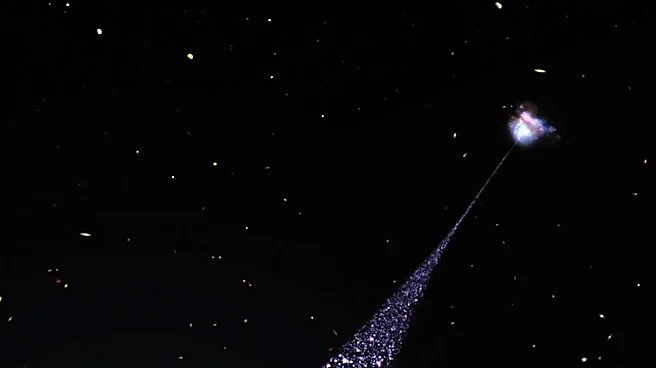
Astronomers have found evidence that a plasma jet emanating from the distant blazar PKS 2233-148 has been gravitationally lensed. This phenomenon, predicted by Albert Einstein's theory of general relativity, occurs when a massive object warps space, altering
the path of light. In this specific case, researchers observed a sudden deviation in the jet's expected trajectory and peculiarities in its gamma-ray curve. The blazar PKS 2233-148 is a type of quasar where supermassive black holes are surrounded by vast amounts of matter, with some material being ejected as plasma jets directed towards Earth. The team, led by Silke Britzen, reanalyzed data from the Very Long Baseline Array, the Fermi space telescope, and the Swift space observatory to track the jet's motion over time. The absence of any visible massive object, such as a galaxy or galaxy cluster, in the position to cause this lensing effect suggests that an invisible cluster of dark matter is responsible. Dark matter does not interact with electromagnetic radiation, making it undetectable by conventional means, but its mass can still warp space.
Why It's Important?
This discovery is significant because it provides potential new insights into the nature and distribution of dark matter, a mysterious substance that constitutes a large portion of the universe's mass but remains largely unobserved. Gravitational lensing by dark matter offers a unique way to study its presence and properties, as it directly demonstrates dark matter's gravitational influence. Furthermore, blazars like PKS 2233-148 are considered potential cosmic accelerators of neutrinos, which are elusive, electrically neutral particles with very low mass. The study of this gravitationally lensed blazar could help solidify the link between blazars and neutrino production, aiding in the hunt for the sources of these 'ghost' particles. Understanding the mechanisms behind neutrino emission could unlock fundamental knowledge about high-energy astrophysical processes and the extreme environments around supermassive black holes.
What's Next?
Researchers plan to search for other similar gravitational lensing events to further confirm the connection between blazars and the origin of neutrinos, as well as to gather more data on dark matter substructures. The temporary and precise alignment required for such lensing events makes them challenging to detect, but finding more instances would strengthen the current findings. Continued observations of blazars and their jets, particularly those that exhibit gravitational lensing, will be crucial. This ongoing research could lead to a better understanding of how dark matter is distributed in the universe and its role in cosmic phenomena. The team's work, published in the *Monthly Notices of the Royal Astronomical Society*, sets the stage for future investigations into these complex astrophysical interactions.
Beyond the Headlines
The potential confirmation of dark matter causing gravitational lensing in this manner could have profound implications for our understanding of cosmology and fundamental physics. It reinforces the existence of dark matter, which has been inferred from various astronomical observations but remains elusive to direct detection. This method of using blazar jets as probes for dark matter could open new avenues for mapping its distribution in regions where traditional methods are difficult. Moreover, if blazars are indeed significant sources of neutrinos, this research could contribute to the emerging field of neutrino astronomy, allowing scientists to 'see' the universe in a new way, beyond electromagnetic radiation. The study highlights the intricate interplay between visible matter, supermassive black holes, and the invisible components of the universe, pushing the boundaries of our cosmic knowledge.