




What's Happening?
India is grappling with widespread drought conditions following significant deficiencies in both the Southwest and Northeast Monsoons. The Southwest Monsoon (SWM), which typically accounts for 75-80% of India's annual rainfall, recorded a 6% deficit,
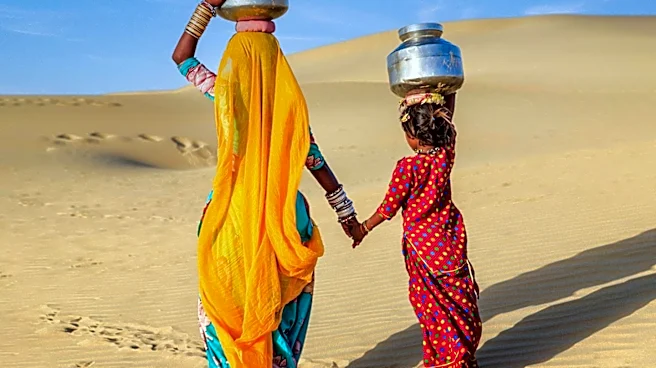
while the Northeast Monsoon (NEM) experienced a substantial 30% shortfall. This dual monsoon failure has led to 240 districts across eight states being declared drought-hit, with an additional 100 districts reporting extensive crop damage. The state of Karnataka alone has declared 223 out of 236 taluks as drought-affected, impacting nearly 48 lakh hectares of cultivated land. Farmers in these regions are suffering significant losses, with many petitioning for government assistance and subsidies. The situation is further exacerbated by a warning from the India Meteorological Department (IMD) about a strengthening El Niño, which typically reduces monsoon rainfall in India. This climate pattern is expected to persist until May 2024, raising concerns about continued water scarcity and agricultural distress.
Why It's Important?
The extensive drought in India has profound implications for its agricultural sector, which is a cornerstone of the national economy and employs a large portion of the population. The significant crop damage and water shortages threaten food security, farmer livelihoods, and could lead to increased food inflation. For the U.S., while not directly impacted by India's monsoon, global agricultural disruptions can influence international commodity markets and food prices. A major agricultural crisis in India could also lead to increased demand for international food aid or impact global supply chains for certain agricultural products. The situation highlights the vulnerability of large agricultural economies to climate variability and the need for robust drought management strategies. The reliance on monsoon rains makes India particularly susceptible to climate patterns like El Niño, underscoring the broader global challenge of climate change adaptation and resilience in agriculture.
What's Next?
The Indian government is expected to continue implementing and potentially expanding relief measures for drought-affected farmers, including subsidies and financial assistance. The National Disaster Response Fund (NDRF) will likely be utilized to provide additional central financial aid to states. There will be increased focus on water conservation efforts, such as rainwater harvesting and efficient irrigation techniques, to mitigate future impacts. The IMD's warning about the strengthening El Niño suggests that authorities will need to prepare for potential continued dry spells and their consequences into the next year. Discussions around strengthening the National Drought Framework and revising the Manual for Drought Management, 2016, are anticipated to ensure more effective and scientific responses to future drought events. The Finance Commission may also review its recommendations regarding state support for disaster management.
Beyond the Headlines
The recurring drought conditions in India, exacerbated by climate phenomena like El Niño, underscore a critical need for long-term, sustainable solutions beyond immediate relief. The subjective nature of drought declarations, often influenced by political considerations rather than purely scientific indicators, highlights a systemic challenge in effective disaster management. There is a deeper implication for agricultural policy, pushing for diversification of crops, promotion of drought-resistant varieties, and investment in advanced agricultural technologies. The situation also brings to light the ethical considerations of climate change, as developing nations like India often bear a disproportionate burden of its impacts despite lower historical emissions. This could fuel calls for greater international cooperation and financial support for climate adaptation in vulnerable regions. Ultimately, the ongoing drought in India serves as a stark reminder of the interconnectedness of global climate patterns, food systems, and socioeconomic stability.