



What's Happening?
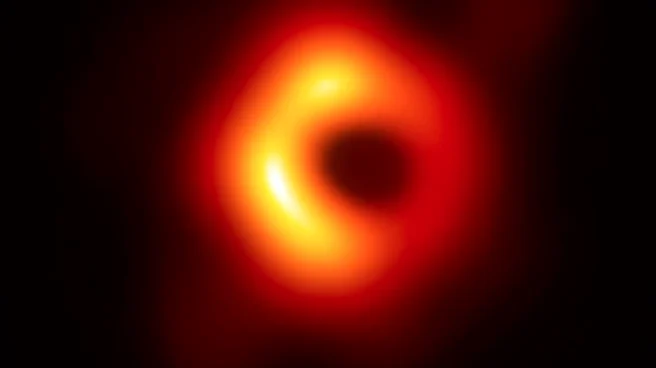
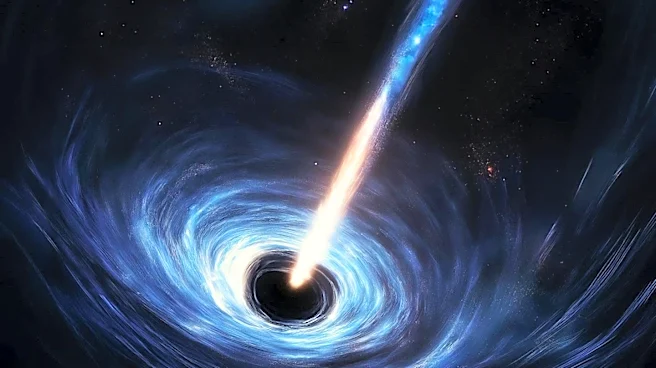
A new framework called BHCast has been developed to unlock black hole plasma dynamics from single, blurry images, such as those captured by the Event Horizon Telescope (EHT). While the EHT provided the first image of a black hole by capturing light from its
accretion flow, these images reveal structure but not the dynamic processes. BHCast, a neural model, addresses this limitation by transforming a static image into forecasted future frames, effectively revealing the underlying dynamics hidden within a single snapshot. Using a multi-scale pyramid loss, this autoregressive forecasting method can simultaneously super-resolve and evolve a blurry frame into a coherent, high-resolution movie that remains stable over long time horizons. From these forecasted dynamics, interpretable spatio-temporal features like pattern speed (rotation rate) and pitch angle can be extracted. BHCast then employs gradient-boosting trees to recover black hole properties, including spin and viewing inclination angle, from these plasma features. The framework has demonstrated effectiveness on simulations of Sagittarius A* and M87*, testing on simulated frames blurred to EHT resolution and real EHT images of M87*.
Why It's Important?
The BHCast framework represents a significant leap in our ability to interpret astronomical data, particularly for black holes. Simulations of black hole accretion dynamics are crucial for understanding EHT images but are computationally expensive and impractical for direct inference. BHCast overcomes this bottleneck by providing a scalable paradigm for solving inverse problems, allowing scientists to extract dynamic information from static, resolution-limited data. This capability is vital for understanding the complex physics of black hole environments, including the behavior of plasma, magnetic fields, and the processes that lead to powerful jets. By enabling the recovery of black hole properties like spin and viewing inclination angle from plasma features, BHCast offers a new method for characterizing these extreme objects, complementing direct observational techniques. This advancement could lead to a deeper understanding of how black holes grow, interact with their surroundings, and influence galactic evolution.
What's Next?
The BHCast framework is poised to become a valuable tool for astronomers and astrophysicists working with EHT data and similar resolution-limited observations. Its ability to forecast long-term dynamics from a single image means that future EHT observations, even if infrequent, can yield a wealth of dynamic information. The modular flexibility, interpretability, and robust uncertainty quantification offered by BHCast will allow researchers to refine their models of black hole accretion and test theoretical predictions against empirical data more effectively. Further development may involve integrating BHCast with other observational techniques and theoretical models to create a more comprehensive picture of black hole physics. The methodology's success in unlocking insights from blurry scientific data suggests its potential application to other fields where dynamic processes are obscured by observational limitations, paving the way for new discoveries across various scientific disciplines.
Beyond the Headlines
BHCast's innovative approach to extracting dynamic information from static images has broader implications for scientific research beyond black holes. It highlights the transformative power of artificial intelligence and machine learning in overcoming fundamental observational limitations. The ability to 'super-resolve' and 'evolve' blurry data into high-resolution, dynamic representations could revolutionize fields ranging from medical imaging to materials science, where obtaining clear, continuous observations is challenging. Ethically, the framework's interpretability and robust uncertainty quantification are crucial, ensuring that AI-derived insights are transparent and verifiable, preventing the 'black box' problem often associated with complex neural networks. Culturally, BHCast underscores the ongoing shift in scientific methodology, where computational tools are becoming as essential as telescopes and particle accelerators in pushing the boundaries of knowledge. It represents a paradigm shift in how we approach data analysis, moving from merely observing to actively inferring and forecasting complex physical phenomena from limited information.