



What's Happening?
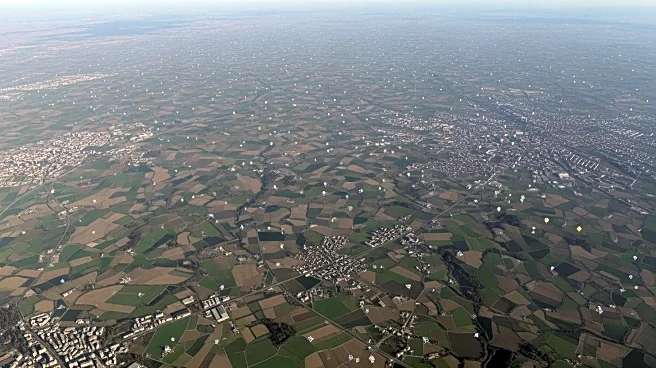
The LPAE-YOLOv8 model has been introduced as an enhancement to the existing YOLOv8 architecture, specifically targeting improvements in small object detection within aerial imagery. The model incorporates a lightweight shuffle-enhanced head (LSE-Head)
and adaptive attention mechanisms to address the challenges posed by small objects in complex backgrounds. The original YOLOv8 architecture, known for its feature extraction and fusion capabilities, has been modified to include a P2 detection layer, which enhances the detection of objects as small as 4x4 pixels. This addition aims to preserve low-level feature information that is often lost in deeper layers. The LSE-Head design replaces traditional convolutional layers with more efficient structures like the ShuffleNetV2 module and depthwise separable convolutions, reducing computational costs while improving feature interaction and detection accuracy.
Why It's Important?
The development of the LPAE-YOLOv8 model is significant for industries relying on aerial imagery, such as surveillance, environmental monitoring, and disaster management. By improving the accuracy of small object detection, the model enhances the ability to monitor and analyze environments where small details are crucial. This advancement could lead to more effective resource management and decision-making processes in these fields. Additionally, the model's efficiency in computational resource usage makes it a viable option for deployment in real-time applications, where speed and accuracy are critical. The improvements in detection accuracy and computational efficiency could also influence future developments in machine learning models for object detection, setting a new standard for balancing performance and resource use.
What's Next?
Future developments may focus on further optimizing the LPAE-YOLOv8 model for specific applications, such as integrating it with drone technology for enhanced real-time monitoring capabilities. Researchers might explore additional modifications to the model's architecture to improve its adaptability to various environmental conditions and object types. There is also potential for collaboration with industries that could benefit from these advancements, leading to tailored solutions that address specific operational needs. As the model gains traction, it may prompt further research into lightweight, efficient object detection models, influencing the broader field of computer vision and machine learning.
Beyond the Headlines
The introduction of the LPAE-YOLOv8 model highlights the ongoing trend towards more efficient and specialized machine learning models. This development reflects a broader shift in the field towards creating models that are not only accurate but also resource-efficient, making them suitable for a wider range of applications. The focus on small object detection also underscores the importance of addressing specific challenges within the field of computer vision, paving the way for more targeted innovations. As these models become more sophisticated, ethical considerations regarding their use in surveillance and privacy will likely become more prominent, necessitating discussions around responsible deployment and regulation.