








What's Happening?
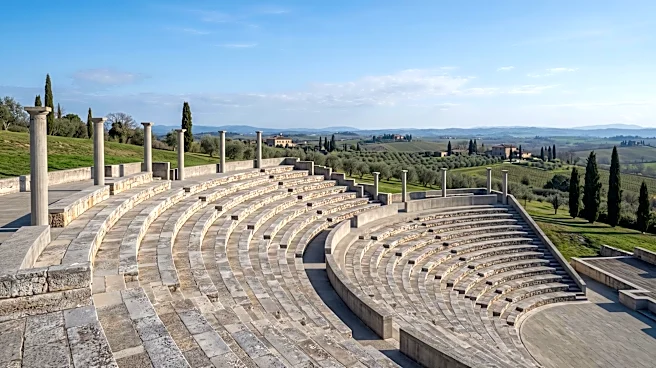
Franco Malosso, an Italian man, has been jailed for 28 months and fined for constructing and operating a fake ancient Greek amphitheater in Arcugnano, Italy. After a 10-year legal battle, Italy's supreme court, the Corte di Cassazione, upheld his conviction
for forging works of art, carrying out unauthorized building works, and destroying a protected landscape. Malosso charged visitors up to 40 euros to tour the nearly 54,000-square-foot site, which he claimed was an ancient Greek discovery. He had hired local builders to construct tiered seating, artificially age the structures, and add cement columns and plaster statues around a man-made pool. Despite obvious historical inaccuracies, such as the site's location far from any ancient Greek colonization and the use of modern materials, the 'amphitheater' received glowing reviews on TripAdvisor.
Why It's Important?
This case highlights the vulnerability of the tourism industry to elaborate scams and the potential for cultural heritage to be exploited for profit. Italy, a country rich in legitimate historical sites, has been particularly scandalized by this deception. The incident underscores the importance of authenticity in cultural tourism and the need for visitors to be discerning about the attractions they visit. For law enforcement, particularly units like Italy's Carabinieri’s Nucleo Tutela Patrimonio Artistico (TPC), it represents an unusual but significant challenge in combating art forgery, extending beyond traditional stolen artworks to entire fabricated archaeological sites. The conviction also sends a strong message about the legal consequences of unauthorized construction and environmental damage, especially in protected landscapes like the Berici Hills where Malosso built his fake site.
What's Next?
Malosso is currently serving his jail term and has been ordered to dismantle the fake amphitheater. However, the process of demolition is expected to be costly, and local authorities, such as the mayor of Arcugnano, have indicated they will not use public funds for its removal. This leaves the fate of the site uncertain, potentially leading to further legal or environmental challenges. The case may also prompt increased scrutiny of tourist attractions, particularly those claiming ancient origins, to prevent similar deceptions. Experts suggest that the incident could lead to greater public awareness regarding the verification of historical sites and the importance of consulting reputable archaeological and historical sources before visiting. The tightening of forgery laws in Italy, allowing for sentences up to five years, indicates a legislative response to such elaborate schemes.
Beyond the Headlines
The 'fake amphitheater' case delves into deeper questions about perception, belief, and the human desire for unique experiences. The fact that visitors, despite the clear anachronisms and historical inaccuracies, praised the site and believed Malosso's narrative, speaks to the power of storytelling and the potential for charismatic individuals to sway public opinion. Archaeologists and art crime experts have expressed both bewilderment at the audacity of the scam and a grudging respect for the sheer scale of the fabrication. This incident serves as a modern parable, echoing historical instances of forgery and illusion, and prompts reflection on how easily 'truth' can be constructed and consumed in the age of information. It also raises questions about the responsibility of platforms like TripAdvisor in vetting the authenticity of listed attractions, especially those purporting to be historical landmarks.