
What's Happening?
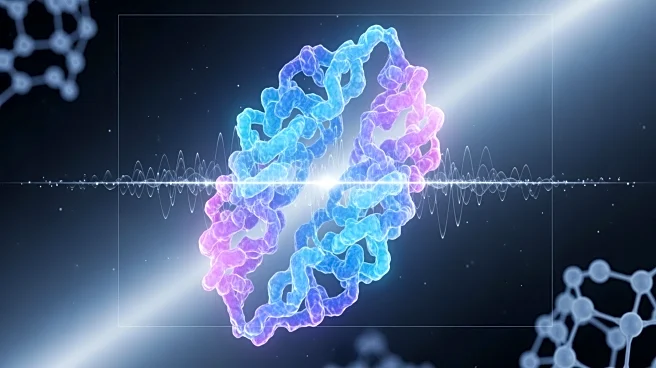
Researchers at the University of Chicago Pritzker School of Molecular Engineering, led by Peter Maurer and David Awschalom, have developed a protein quantum bit (qubit) that can be produced directly inside
living cells. This innovation serves as a magnetic field sensor, offering an alternative to traditional nitrogen-vacancy (NV) center-based qubits, which are typically large and difficult to position within living cells. The team utilized fluorescent proteins, which are only 3 nm in diameter, to achieve this feat. These proteins possess optical and spin properties similar to NV center-based qubits, including a metastable triplet state. The researchers successfully used a near-infrared laser pulse to optically address a yellow fluorescent protein and read out its triplet spin state with up to 20% spin contrast. They further genetically modified the protein to be expressed in bacterial cells, achieving signal measurements with a contrast of up to 8%.
Why It's Important?
This development is significant as it opens new possibilities for magnetic resonance measurements directly inside living cells, a capability that NV centers cannot provide. The ability to produce qubits within cells could revolutionize quantum biosensing, offering more precise and localized measurements in biological environments. This advancement could lead to breakthroughs in understanding cellular processes and developing new medical diagnostics and treatments. The research highlights the potential for integrating quantum technology with biological systems, paving the way for innovative applications in biotechnology and medicine.
What's Next?
The researchers plan to further refine the protein qubit technology to enhance its performance and explore its applications in various biological settings. Future studies may focus on improving the spin contrast and sensitivity of the qubits, as well as expanding their use in different types of cells and organisms. The team may also investigate the potential for these qubits to be used in conjunction with other quantum technologies, potentially leading to new interdisciplinary research areas. The broader scientific community will likely monitor these developments closely, as they could have far-reaching implications for both quantum physics and biological sciences.