






What's Happening?
Tennessee Governor Bill Lee announced the issuance of the nation's first byproduct material license for a commercial nuclear fusion project. This landmark decision, made in conjunction with the Tennessee Department of Environment and Conservation, establishes
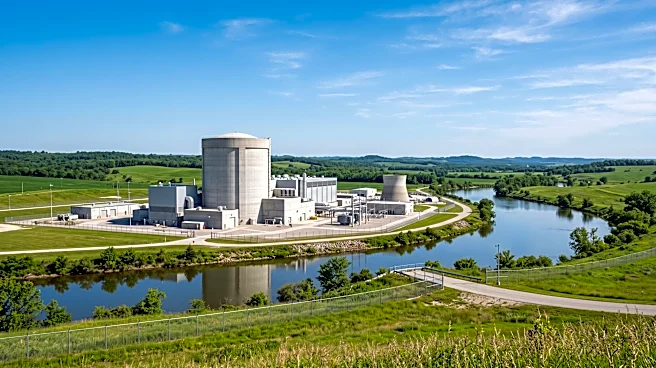
a new regulatory framework designed to accelerate the development of fusion technology. Knoxville-based Type One Energy is the recipient of this license and plans to break ground this year on Project Infinity, a prototype fusion reactor. This facility will be located at the Tennessee Valley Authority's (TVA) closed Bull Run coal-fired power plant in Anderson County. Type One Energy aims to construct the world's first commercial nuclear fusion power plant, utilizing a stellarator design that smashes hydrogen isotopes together at extreme temperatures to release energy, mimicking the process that powers the sun. The state has supported this initiative through a nuclear fund, created by Governor Lee and authorized by the General Assembly, which granted Type One Energy $4.5 million in 2024 and has allocated a total of $95 million since 2023.
Why It's Important?
This development is highly significant for the U.S. energy sector and positions Tennessee as a leader in nuclear innovation. By creating a clear regulatory path for emerging technologies like fusion, Tennessee is actively fostering the next generation of reliable and abundant American energy. The issuance of this license could serve as a model for other states, potentially accelerating the commercialization of fusion energy nationwide. Successful deployment of commercial nuclear fusion could offer a clean, virtually limitless energy source, drastically reducing reliance on fossil fuels and mitigating climate change impacts. This initiative also highlights a strategic partnership between state government, private industry (Type One Energy), and a federal utility (TVA), demonstrating a collaborative approach to tackling complex energy challenges. The economic implications include job creation, technological advancement, and the potential for Tennessee to become a global hub for nuclear energy research and development.
What's Next?
Type One Energy plans to begin construction on Project Infinity, their prototype fusion reactor, this year at the Bull Run site. Following the prototype, the company intends to develop a pilot fusion power plant called Infinity Two, with the goal of fully starting up its first commercial reactor by 2034. The Bull Run site is also slated to become a broader fusion development campus, fostering partnerships with institutions such as Oak Ridge National Laboratory, TVA, and the University of Tennessee. The Tennessee Department of Environment and Conservation's groundbreaking regulatory framework for fusion energy is expected to serve as a model for other states, potentially leading to similar licensing processes across the country. TVA, as a development partner, could gain early access as a customer for the reactor if it successfully generates commercial electricity.
Beyond the Headlines
The issuance of this license represents a profound shift in the regulatory landscape for advanced energy technologies. Historically, the path to commercializing novel energy sources has been fraught with regulatory hurdles. Tennessee's proactive approach in developing a 'safety by design' licensing process for fusion energy could set a precedent for how states can facilitate technological innovation while ensuring public safety. This move also underscores a broader national and global interest in achieving energy independence and sustainability through clean energy solutions. The collaboration between government, academia, and industry in Tennessee could become a blueprint for other states looking to attract and nurture high-tech industries. Furthermore, the transition of a former coal-fired power plant site into a hub for nuclear fusion research symbolizes a strategic pivot towards a cleaner energy future, offering a tangible example of how legacy industrial sites can be repurposed for cutting-edge technologies.