






What's Happening?
The San Diego City Council has unanimously approved a resolution urging the California Legislature and Governor Gavin Newsom to grant local authorities control over the deployment of autonomous vehicles (AVs) within their jurisdictions. The resolution,
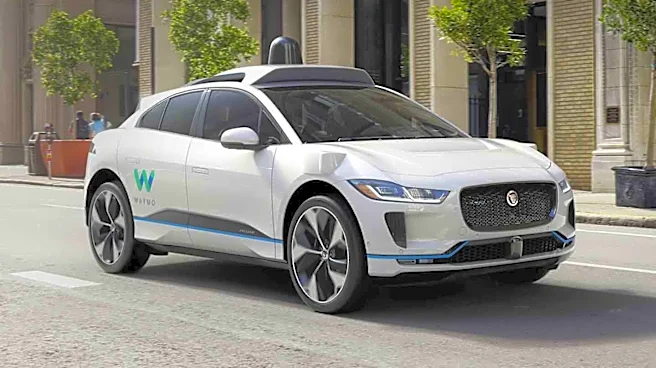
passed with an 8-0 vote, also seeks protections for drivers whose jobs may be impacted by AV technology and specifically calls on the San Diego County Regional Airport Authority to prohibit AVs from operating at San Diego International Airport. This action comes as multiple tech companies, including Alphabet-owned Waymo, Amazon subsidiary Zoox, and potentially Tesla, are expanding or beginning to test their robotaxi services in San Diego. Waymo has already launched its service to early-access customers in a 40-square-mile area of central San Diego, excluding the airport. Currently, AVs in California are regulated by state agencies such as the Department of Motor Vehicles and the Public Utilities Commission, which issue permits and oversee operations, rather than local governments.
Why It's Important?
This resolution highlights a growing tension between state-level regulation and local control regarding emerging technologies like autonomous vehicles. The San Diego City Council's move reflects concerns about public safety, potential job displacement for traditional taxi and rideshare drivers, and the ability of local communities to manage the impact of new technologies on their infrastructure and residents. The resolution's call for local authority over AV deployment could set a precedent for other cities in California and potentially across the U.S., influencing how autonomous vehicle services are integrated into urban environments. The opposition from Waymo, which argues the resolution is 'extraordinarily premature' and could restrict transportation choices, underscores the significant economic stakes for AV companies seeking to expand their operations. The debate also touches on the broader question of who should have the ultimate say in regulating rapidly evolving technological advancements and balancing innovation with community interests.
What's Next?
The San Diego City Council's resolution is a symbolic move intended to pressure state representatives to change existing laws in Sacramento, granting local control over AV deployment. Councilmember Marni von Wilpert indicated that this resolution will initiate a lobbying campaign to advocate for legislative changes. If successful, such changes could significantly alter the regulatory landscape for autonomous vehicles in California, potentially leading to a patchwork of local rules rather than a uniform state-wide approach. Major stakeholders, including AV companies like Waymo and Zoox, will likely continue to engage with state and local governments to protect and expand their operations. The resolution also supports a bill introduced by Rep. Kevin Mullin, the AV Emergency Response Coordination Act, which aims to establish federal requirements for AV manufacturers and operators, including standardized emergency response protocols and a 24/7 hotline for public officials. The outcome of these legislative efforts will determine the future operational framework for AVs in San Diego and potentially beyond.
Beyond the Headlines
The San Diego City Council's resolution delves into deeper implications concerning the balance of power between state and local governance in the face of technological disruption. It raises questions about the democratic accountability of technology deployment, particularly when state-level decisions may not fully address local community concerns. The debate also highlights the ethical considerations surrounding job displacement due to automation, as evidenced by the opposition from taxi and rideshare drivers. Furthermore, the resolution touches on public safety concerns, citing past incidents where driverless vehicles have caused disruptions. The call for 'responsible autonomous vehicle operations' and local compliance with noise and nuisance laws suggests a desire to integrate AV technology in a way that minimizes negative externalities on residential areas and public services. This ongoing discussion will likely shape future policy frameworks, emphasizing the need for comprehensive regulatory approaches that consider economic, social, and safety impacts alongside technological advancement.