


What's Happening?
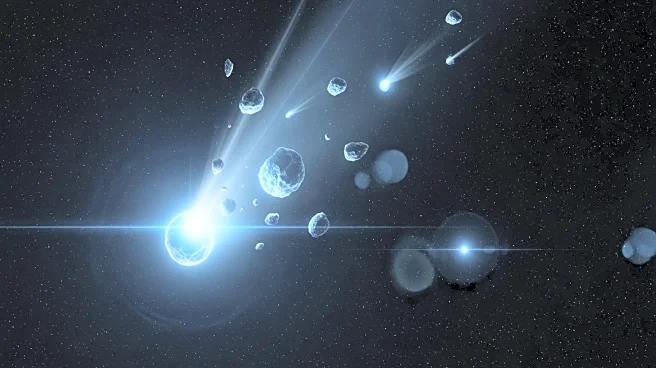
NASA's Hubble Space Telescope has captured a rare astronomical event involving the comet C/2025 K1 (ATLAS), which fragmented into at least four pieces between November 8 and November 10. This event was observed as the comet was surrounded by a 'fuzzy
envelope of gas and dust' that envelops its icy nucleus. The observation was serendipitous, as the original target for the telescope was not viewable due to technical constraints, leading researchers to select K1 as an alternative. The comet, approximately five miles long, had recently made its closest approach to the sun, a period during which comets experience intense heating and stress, often leading to fragmentation. The fragments are now floating about 250 million miles away from Earth in the constellation Pisces.
Why It's Important?
The fragmentation of comet K1 provides scientists with a unique opportunity to study the composition of comets, which are considered remnants from the early solar system. These celestial bodies contain primordial materials that have not been processed, offering insights into the conditions and materials present during the solar system's formation. The accidental capture of this event by Hubble underscores the challenges and unpredictability of astronomical observations, yet it also highlights the potential for unexpected discoveries that can advance scientific understanding. The data gathered from this event could help answer questions about the evolution of comets and the solar system.
What's Next?
While the comet K1 is not expected to return, the data collected from its fragmentation will be analyzed to understand the composition and behavior of comets better. Researchers will likely continue to monitor similar events to gather more information about the processes that lead to comet fragmentation. This could involve scheduling future observations with Hubble or other telescopes to capture similar phenomena, despite the inherent difficulties in predicting and observing such rare events.