






What's Happening?
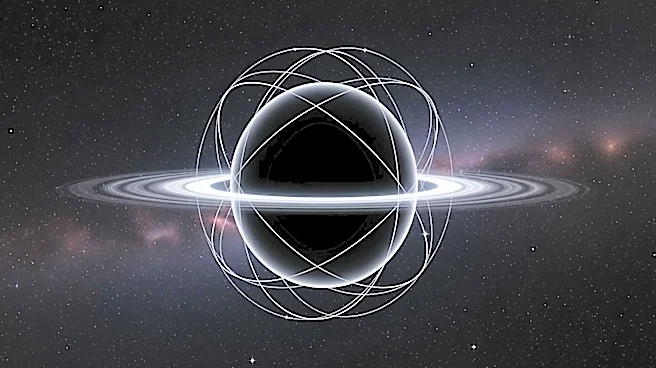
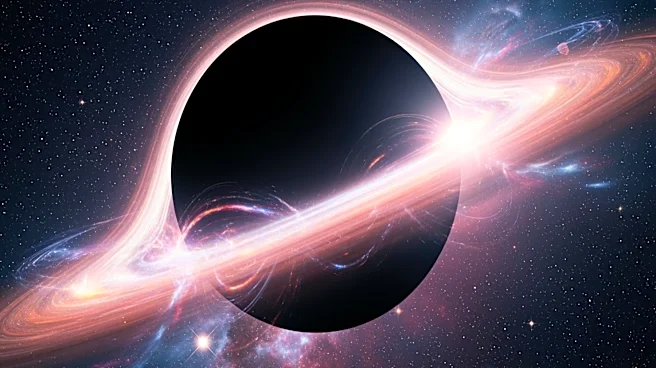
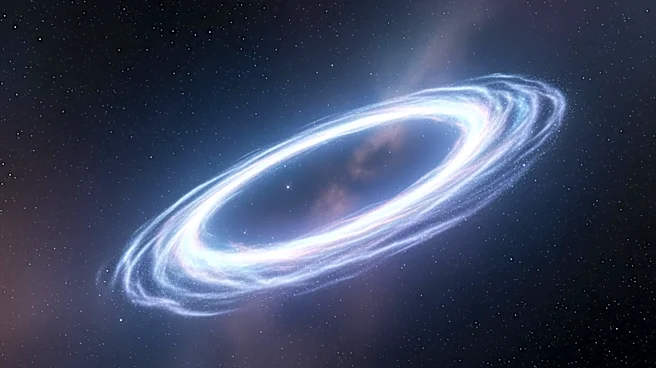
Astronomers have uncovered statistical evidence suggesting that supermassive black holes (SMBHs) can be 'kicked' out of their galactic centers following mergers. This phenomenon, predicted by Einstein's theory of general relativity, occurs when merging
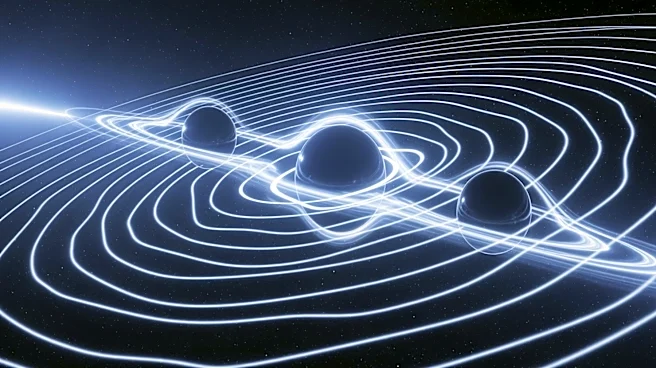
black holes emit gravitational waves, causing them to accelerate at high speeds. The study, published on the arXiv preprint server, used the correlation between a black hole's velocity and the surrounding dust to identify these recoiling SMBHs. The research provides a new method to track these fast-moving cosmic entities, which have been challenging to detect.
Why It's Important?
This discovery offers significant insights into the dynamics of galactic evolution and the behavior of black holes. Understanding the mechanisms behind black hole recoils can help astronomers predict the future of galaxies and the distribution of matter in the universe. The findings also have implications for future gravitational wave observatories, which could detect these events and provide further data on cosmic phenomena. This research enhances our understanding of the universe's structure and the forces shaping it.
What's Next?
The study's authors anticipate that next-generation gravitational wave observatories, such as ESA's LISA mission, will provide more data on recoiling black holes. These observatories could confirm the statistical findings and offer a more comprehensive view of black hole dynamics. Further research may focus on refining the methods used to detect these phenomena and exploring the implications for galaxy formation and evolution. The potential for new discoveries in this field is vast, with the possibility of uncovering more about the universe's most enigmatic objects.