






What's Happening?
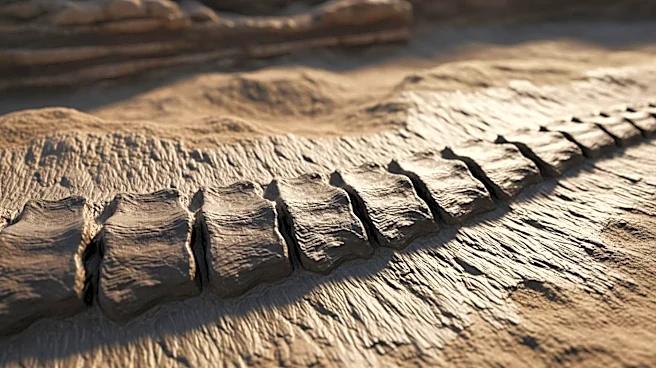
Researchers have discovered an 80-million-year-old dinosaur tail on Denman Island, off the coast of British Columbia, Canada. This fossil is believed to belong to an ornithomimosaur, a type of fast-running, bird-like theropod dinosaur that lived during
the Cretaceous period, approximately 145 to 66 million years ago. The tail bone, identified as the 10th bone of the caudal vertebra, was found isolated and is thought to have been deposited on the island by a floating carcass or transported by another scavenging dinosaur. The discovery was made through CT scans and 3D modeling, which compared the fossil to known ornithomimosaur and tyrannosaur skeletons. This finding provides the clearest evidence yet that these ostrich-like dinosaurs once roamed the Pacific coastline of North America.
Why It's Important?
The discovery of the ornithomimosaur tail in Canada is significant as it adds to the understanding of the distribution and diversity of dinosaurs in North America. It suggests that these bird-like dinosaurs inhabited the western margin of the continent, expanding the known range of these species. This finding could lead to further paleontological exploration in the region, potentially uncovering more fossils that could provide insights into the evolutionary history and ecological dynamics of the Cretaceous period. The research highlights the importance of fossil discoveries in piecing together the prehistoric past and understanding the biodiversity of ancient ecosystems.
What's Next?
Further fossil discoveries in the region could provide more detailed information about the ornithomimosaur and its relatives. Researchers may continue to explore Denman Island and surrounding areas for additional evidence of these dinosaurs. The study suggests that more comprehensive fossil records are needed to determine how these dinosaurs differed from those found elsewhere in North America. Continued research and exploration could lead to new insights into the migration patterns, habitat preferences, and evolutionary adaptations of these prehistoric creatures.