


What's Happening?
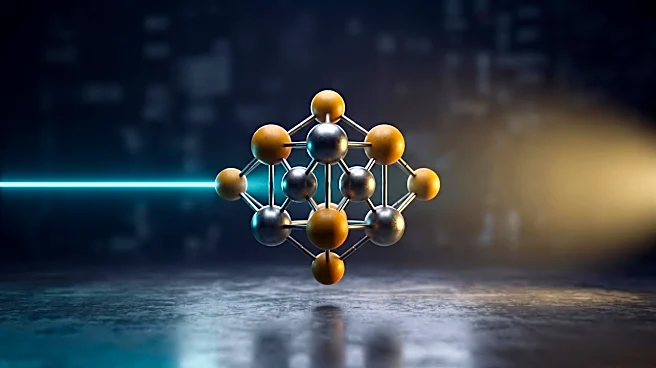
Researchers from IBM, RIKEN, and other institutions utilized an IBM quantum computer in conjunction with the Fugaku supercomputer to perform calculations on an iron-sulfur cluster. This molecular structure is crucial in biological processes like photosynthesis
and cellular respiration. The IBM quantum computer ran a circuit involving 77 qubits and over 10,000 quantum gates, with the Fugaku supercomputer assisting in processing the results. This research, published in Science Advances, explores 'Chemistry beyond the scale of exact diagonalization on a quantum-centric supercomputer.' The collaboration aims to understand the boundary of quantum advantage, where quantum computers can outperform classical approaches for specific computational tasks. A new classical algorithm developed by a Michigan State University student was able to reproduce these energy calculations efficiently, completing them in under a minute on a standard MacBook Pro, and even faster with GPU optimization.
Why It's Important?
This collaborative approach highlights a growing trend in advanced computing: the integration of quantum and classical systems to tackle complex scientific problems. The ability to calculate the energy of an iron-sulfur cluster has significant implications for understanding fundamental biological processes, potentially leading to advancements in fields such as medicine and renewable energy. The development of a classical algorithm that can efficiently reproduce these quantum calculations is also crucial. It helps redefine the 'quantum advantage boundary,' indicating where classical methods remain effective and where quantum computing offers a distinct benefit. This interplay between quantum and classical computing suggests that the most powerful solutions may come from their combined strengths, with classical hardware assisting in pre- and post-processing while quantum computers handle specific, computationally intensive parts of a problem. This research contributes to the ongoing effort to determine the optimal roles for both types of computing in scientific discovery.
What's Next?
The ongoing exploration of the quantum advantage boundary will continue to drive research in both quantum and classical computing. Future efforts will likely focus on refining algorithms for both types of systems and developing hybrid approaches that leverage their respective strengths. The classical algorithm developed in this research is being considered for incorporation into IBM’s quantum circuit software, which could make it more accessible to a wider research community. This integration would allow for more efficient classical simulations of quantum experiments, further aiding in the understanding and optimization of quantum circuits. As quantum hardware continues to improve and classical algorithms become more sophisticated, the dynamic boundary between these computing paradigms will continue to shift, leading to new discoveries and applications. The emphasis will be on developing robust and trustworthy software ecosystems that can effectively utilize these evolving technologies.
Beyond the Headlines
The convergence of quantum computing and supercomputing, as demonstrated by this research, signifies a paradigm shift in scientific computation. It underscores the idea that future breakthroughs may not come from isolated advancements in one technology but from their synergistic integration. This approach raises important questions about the ethical and practical implications of increasingly powerful computational tools. Ensuring the trustworthiness and reproducibility of results from these hybrid systems will be paramount, especially as they are applied to critical areas like drug discovery and materials science. The development of efficient classical algorithms that can validate or even replicate quantum results also highlights the continuous evolution of computational science, where new methods constantly challenge and redefine the capabilities of existing technologies. This dynamic interplay fosters a deeper understanding of the underlying physics and mathematics, pushing the boundaries of what is computationally possible.