




What's Happening?
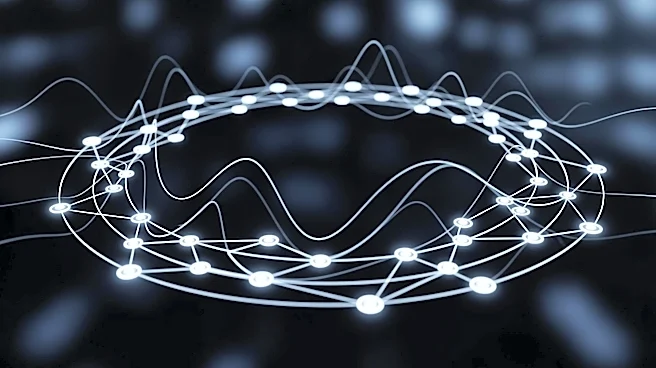
Researchers Ian Whitehouse, Hoony Kang, and Wolfgang Losert have developed a 'rhythmic sharing' algorithm inspired by the oscillatory behavior of astrocytes in the brain. This algorithm is designed to detect subtle shifts in complex data streams, a phenomenon
known as concept drift. The algorithm's core innovation lies in its sinusoidally varying recurrent links, which enhance sensitivity to distributional drift. Testing on datasets such as NASA C-MAPSS, SWaT, and WADI demonstrated significant improvements in F1-scores, indicating the algorithm's effectiveness in identifying anomalies in complex systems. The research suggests that oscillatory link dynamics could be a general computational principle with implications for neuromorphic hardware and understanding astrocytic network biology.
Why It's Important?
The development of this algorithm is significant for industrial safety and process optimization, as it enhances the ability to detect subtle shifts in complex systems. This capability is crucial for preventing catastrophic failures in industries reliant on complex data streams, such as aerospace and water treatment. By improving drift detection, the algorithm can lead to more reliable and efficient operations, potentially reducing costs and increasing safety. Furthermore, the research highlights the potential of biologically-inspired computing, which could lead to advancements in neuromorphic hardware and a deeper understanding of brain-like processes in artificial intelligence.